URD 2025
-
1 ■ Presentation of the Group and its activities
- 1.1 A global provider of recycling and public sector services
- 1.2 Recycling business
- 1.3 Public Sector Services business
- 1.4 Stake in Elior Group
- 1.5 Strategies and objectives
- 1.6 Group structure
1.1 A global provider of recycling and public sector services
1.1.1 Services organized into two businesses
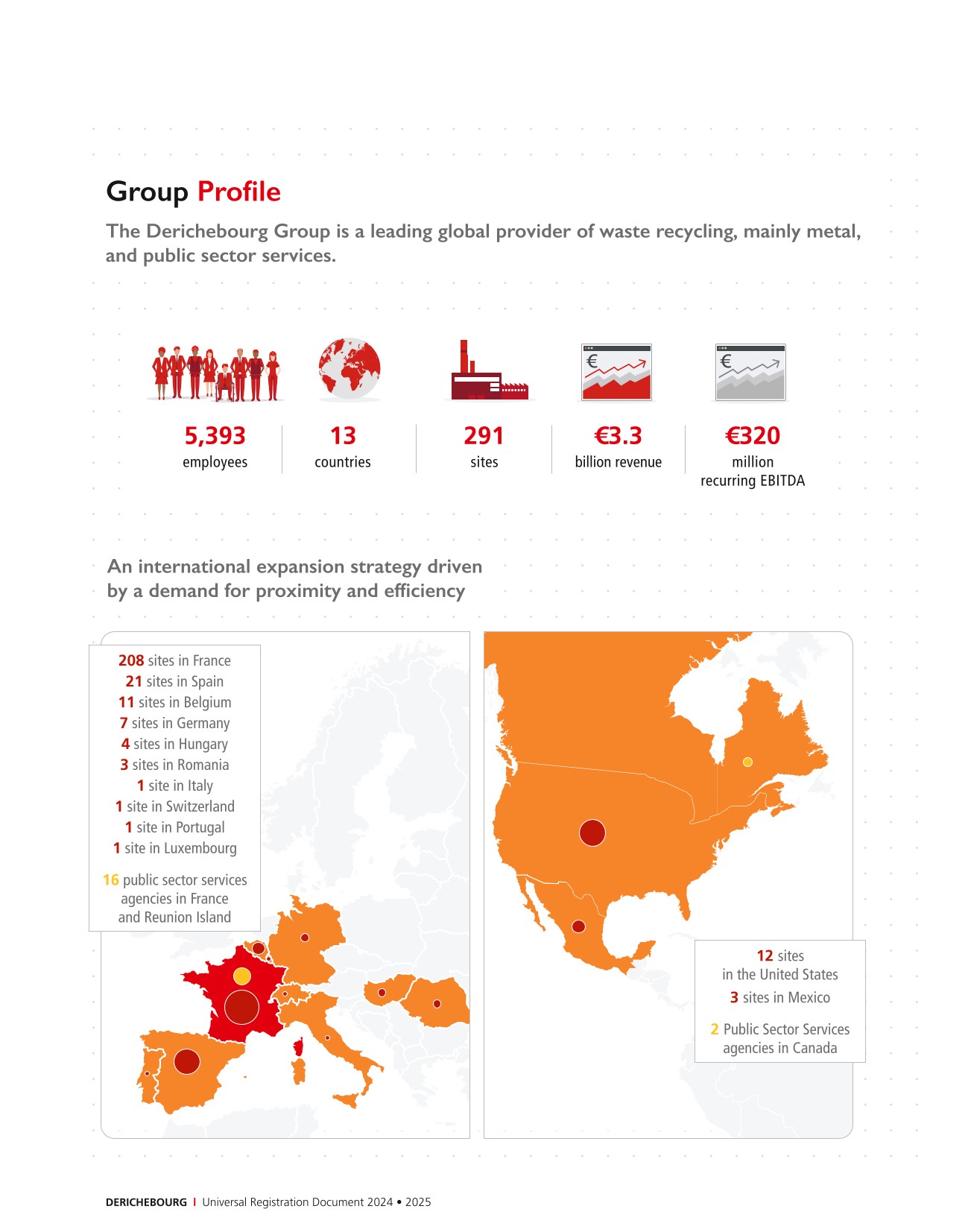
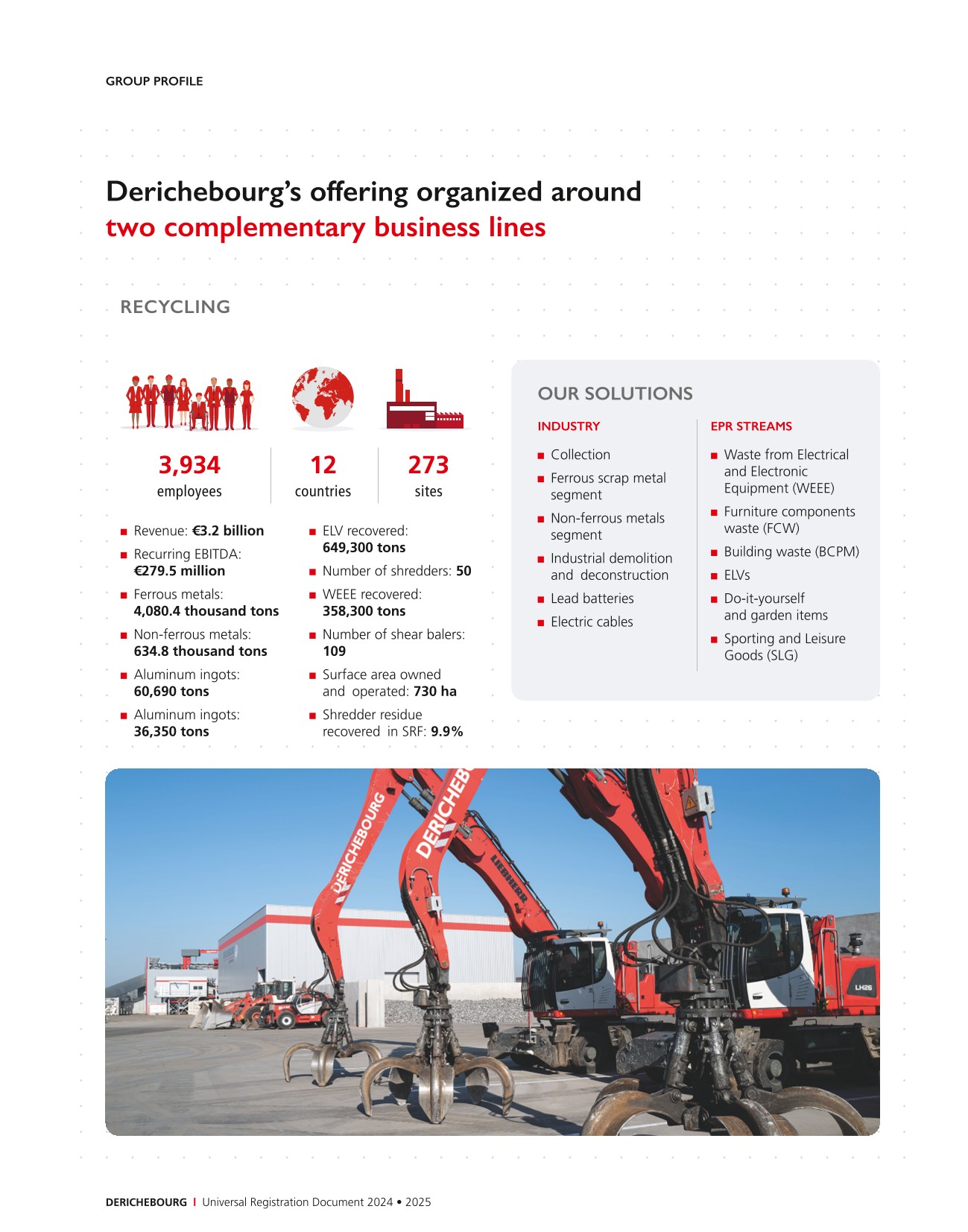
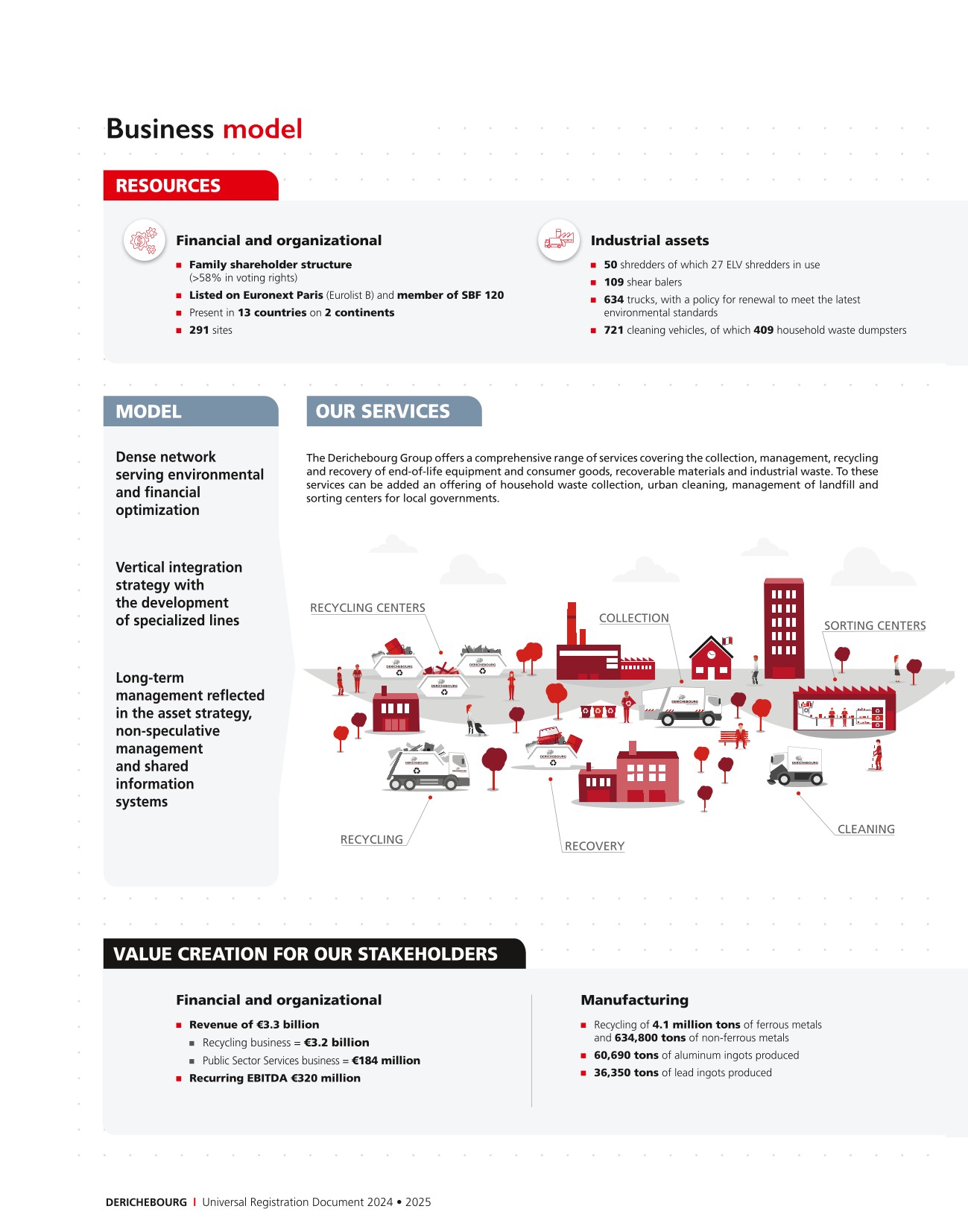
The Derichebourg Group is a leading global provider of waste recycling, mainly metal, and public sector services.
Derichebourg's offering covers the recycling of ferrous and non-ferrous waste, from collection to recovery, and various household waste collection services on behalf of local governments.
Historically, the purpose of the Recycling business is to recover ferrous and non-ferrous waste from end-of-life products, and process them in the appropriate way to produce raw materials from recycling. This business has become a cornerstone of international environmental protection policy. The business is often tied to the cycles of the steel and metalwork industries, which are the consumer sectors of the products sold by the Group.
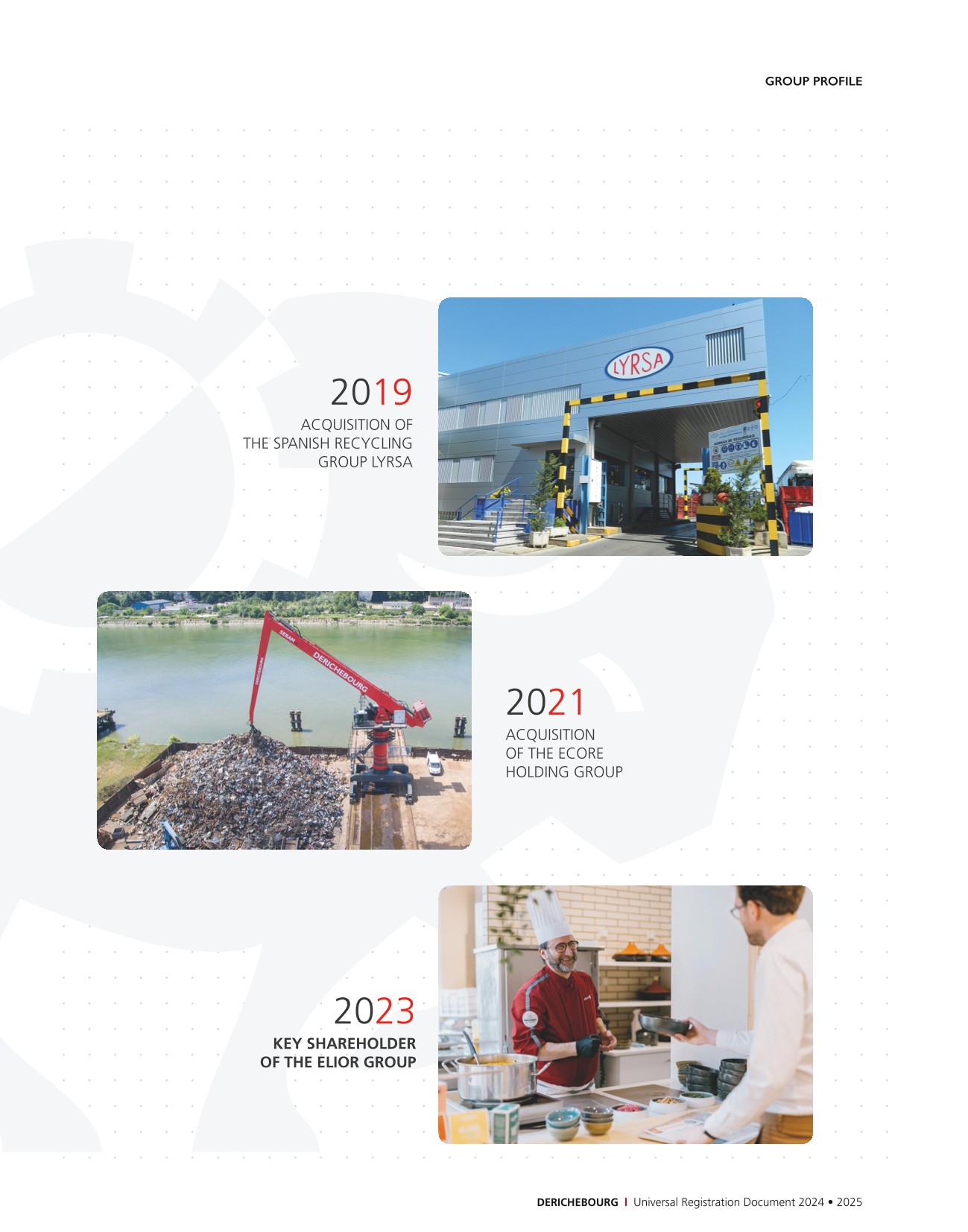
Since the mid-2000s, the desire to add a more resilient business to Recycling was reflected in the acquisition of Multiservices businesses, which covers cleaning, temporary work, energy and outsourced aeronautical services. In April 2023, the Multiservices division was contributed to Elior Group and paid for by issuing new shares in this French contract catering and business services company, bringing the Derichebourg holding to 48.31%. Following the capital increase of Elior Group on April 8, 2024 through the issue of 741,520 new shares, relating to its 2021 bonus share allocation plan, the Derichebourg Group’s stake was reduced to 48.17%.
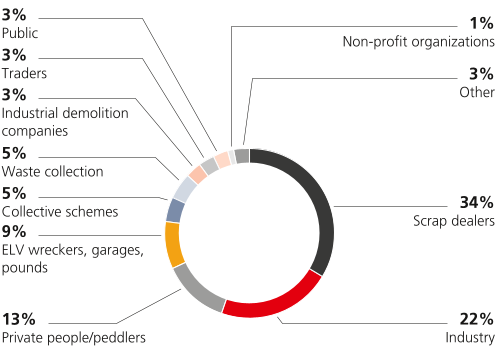
Main markets
-
1.2Recycling business
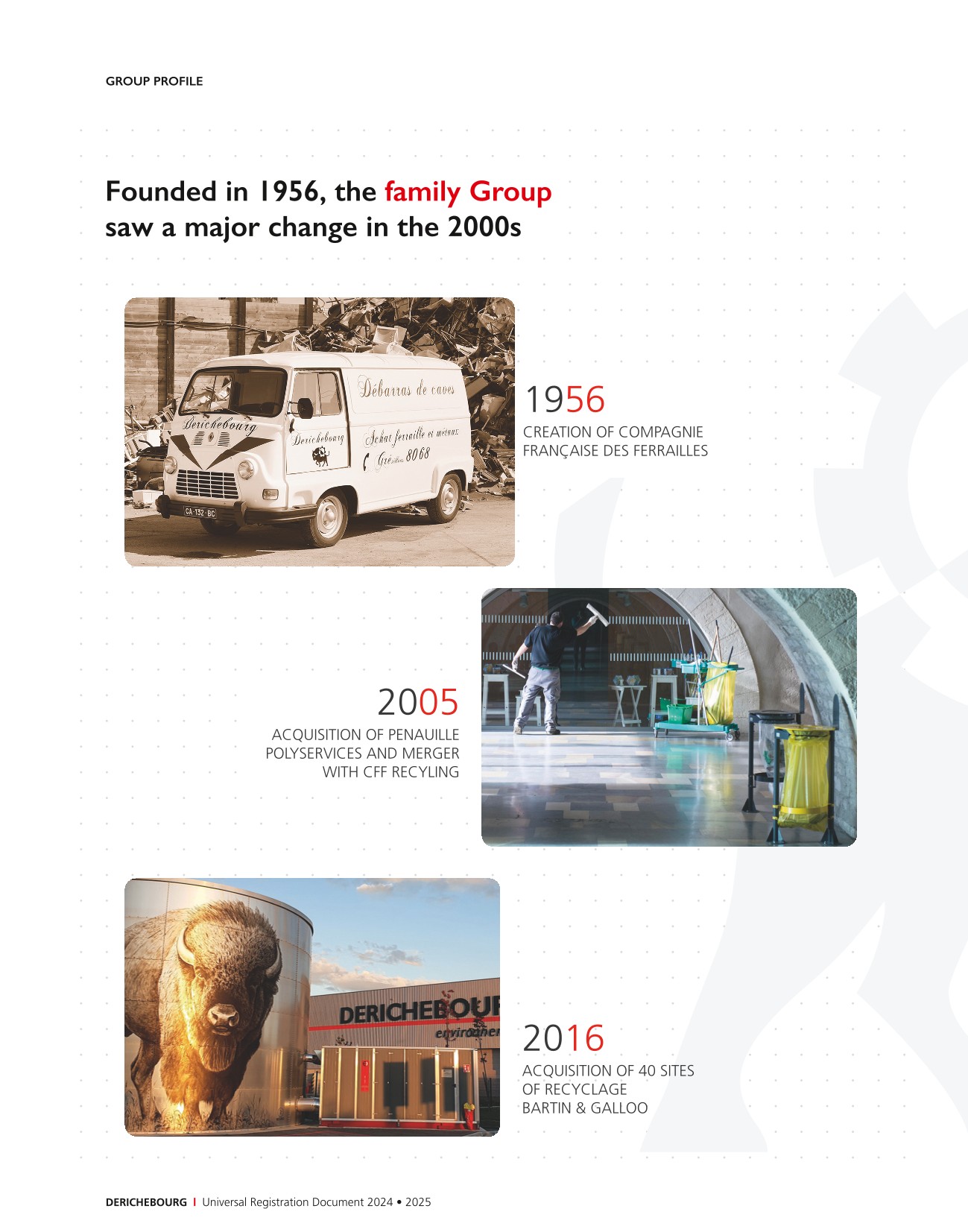
Since 1956, the business of Derichebourg Environnement has been the collection, sorting, recycling and recovering of ferrous and non-ferrous metals in end-of-life consumer goods (automobiles, waste electrical and electronic equipment, etc.), as well as in recuperation material (industrial demolition, for example) and new scrap from metal transformation processes (production waste).
1.2.1The recycling market
1.2.1.1 The ferrous scrap metal recycling market
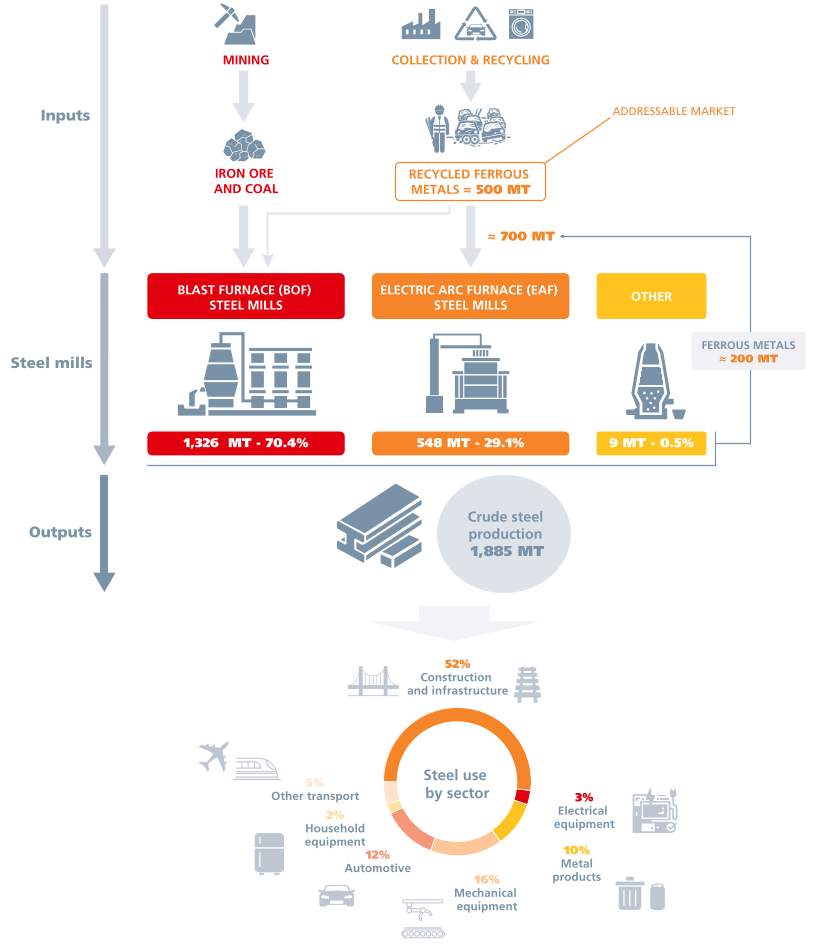
The ferrous scrap metal recycling market is at the interface between an upstream market (waste supply) and a downstream market (steel mill needs).
The annual ferrous scrap metal market is estimated at 700 million metric tons (source: BIR), of which 500 million metric tons are accessible to recycling companies, with the balance comprising steel waste that is recycled internally.
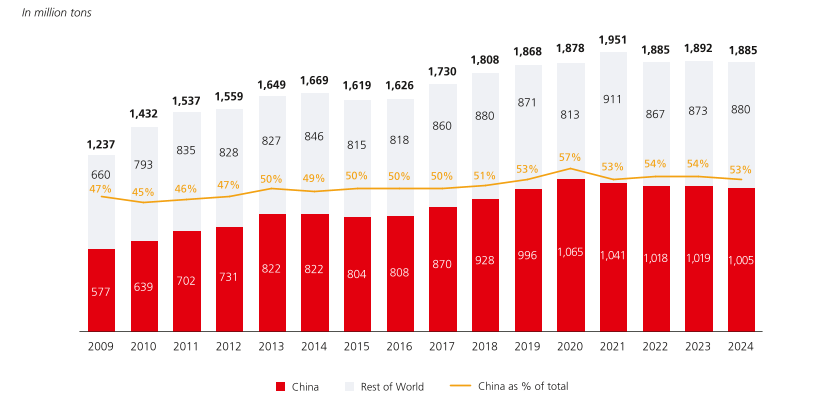
The global steel production reached a high point in 2021 (1,951 million metric tons) and has declined slightly since then. In 2024, it was 1,885 million metric tons. China alone accounts for 53% of global production. At the same time, the installed production capacity continued to increase (around 2,500 million metric tons). The industry is faced with overcapacity, mainly in China.
Blast furnaces consume iron ore, coke, and a small proportion of ferrous scrap metals (10-15%), which reduces greenhouse gas emissions. Electric steel mills consume ferrous scrap metals almost exclusively.
In theory, both types of mills can produce any type of steel. In practice, steel from electric steel mills is used to produce long steel and reinforcing bars. Coils are made mostly at blast furnaces.
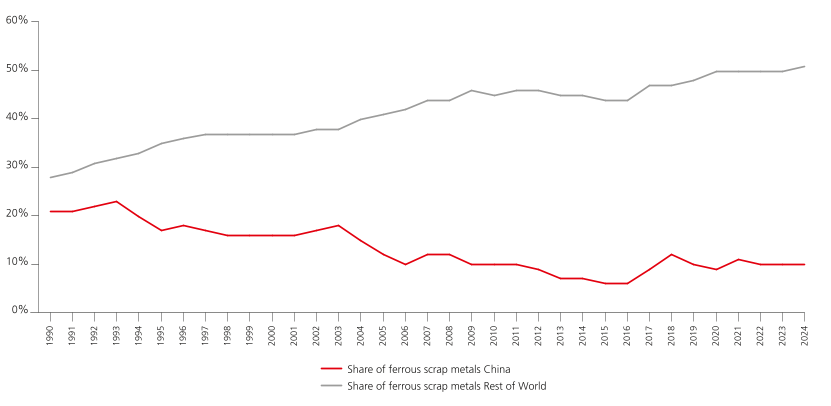
As can be seen in the previous graph, the share of steel from electric steel mills tends to increase from year to year on a regular basis in countries other than China. The competitive advantages of steel from electric mills are as follows:
- ■less investment;
- ■increased flexibility of use, with the ability to stop and restart production;
- ■very clear environmental benefit (fewer greenhouse gas emissions per metric ton produced with a ratio of 1 to 2.3) and energy benefit (less energy consumed per metric ton produced) advantage compared to blast furnaces, especially in countries where the nuclear share of the energy mix is high;
- ■local supply;
- ■ease of access to steel production for developing countries thanks to lower investment.
The ferrous scrap metal market is also sensitive to international steel and ferrous scrap metal trade flows.
The intensity of Chinese and Turkish steel exports significantly influences the European steel market and consequently its need for ferrous scrap metal. Starting in mid-2016, China has sharply reduced its steel exports to Europe due to its strong domestic demand, which has allowed European and Turkish steelmakers to improve their production and sales in their local market. The Group’s European customers, and indirectly the Group, have benefited from this situation. Since mid-2022, these Chinese steel exports have increased again, due to a decline in domestic demand and a stable production surplus, as well as higher electricity costs in Europe. Chinese semi-finished products are less expensive than those made in Türkiye or Europe. Chinese steel exports increased from 51 million metric tons in 2022 to 117 million metric tons in 2024, representing 26% of global exports. These exports compete with European steelmakers in their own markets, and, therefore, with the Group’s main customers by volume.
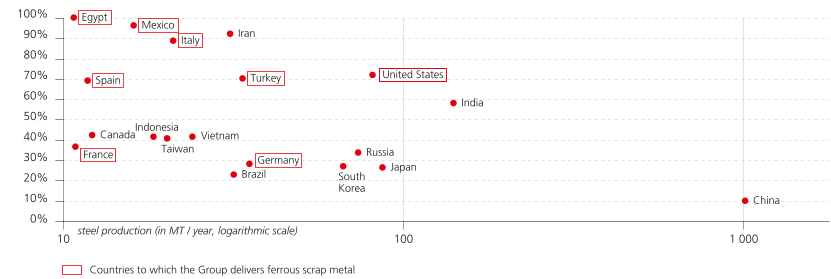
Türkiye is the world’s largest importer of ferrous scrap metal. It produces 37 million tons of steel (2024), 70% of which comes from electric steel mills, with insufficient local raw materials, and imports about 20-25 million metric tons of ferrous scrap metal per year, i.e. one quarter of the global trade. Unlike domestic markets, where price negotiations with steel mills occur monthly, the Turkish market buys ships on the spot market (up to 40,000 t). This means that changes in Turkish prices have an effect on the supply regions of the United States and Europe, which have a surplus of ferrous scrap metals. The economic situation in Türkiye is also a factor that influences the ferrous scrap metal market.
In recent decades, globalization and the liberalization of international trade resulted in the virtual disappearance of customs tariffs. Consequently, it was marginal demand that influenced world prices. Since the spring of 2018, the situation has changed, with the introduction of customs tariffs by the United States on the majority of steel imports. In 2024, the United States announced a new round of customs tariffs on the whole world, at varying rates. Although the products sold by the Group are not directly affected, this will once again change the flow of international trade.
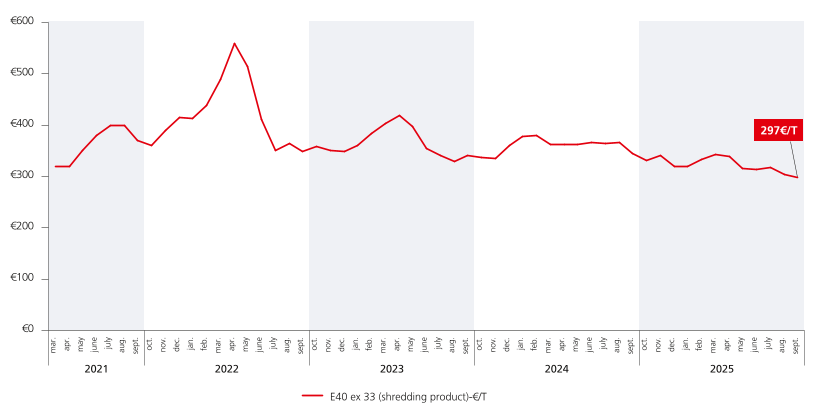
The ferrous scrap metal recycling market is perceived as relatively volatile, insomuch as price and volume trends often compound: increased ferrous scrap metal demand by steelmakers will result in scarcity of the additional metric tons sought and put upward pressure on prices. If demand falls, the opposite happens.
End-of-life consumer goods (around 80%, including industrial demolition) and production waste from steel processing (around 20%) provide ferrous scrap metal purchasers with their supplies. The level of general economic activity therefore influences the availability of ferrous scrap metal.
1.2.1.2The non-ferrous metals (NFM) recycling market
The actors in both ferrous and non-ferrous scrap metal recycling are often the same. The volumes of non-ferrous metals processed by collectors are much lower (often one-tenth of the volume) than for ferrous scrap metals. Conversely, unit prices are much higher, as are unit margins.
The tonnage collected in France by NFM operators is 1.78 million metric tons (2024 FEDERREC figures).
For the French market (68% of the tonnage collected by the Group), the breakdown of non-ferrous metals sold by the profession is as follows:
- ■aluminum and aluminum cables: 33%;
- ■lead and batteries: 9%;
- ■stainless steel and alloys: 15%;
- ■copper, excluding cables and motors: 10%;
- ■zinc: 4%;
- ■copper cables: 3%;
- ■brass and alloys: 4%;
- ■electric motors; 7%;
- ■other: 15%.
NFM to be recycled are found primarily in buildings, packaging, automobiles and industrial equipment. User industries are essentially foundries, refineries and other heavy industries.
Recycling of end-of-life products will become increasingly essential since it is the only source of secondary non-ferrous metal, whereas primary resources are shrinking. Several other factors also favor the development of non-ferrous metal recycling. First, the production of primary ore is nonexistent in many areas of the world. Recycled products are thus the only “surface mine” available and are also a renewable source; in all cases, the reutilization of recovered products leads to savings in raw materials. It avoids CO2 emissions and creates energy savings compared to the production of the same quantity of metal by the primary sector.
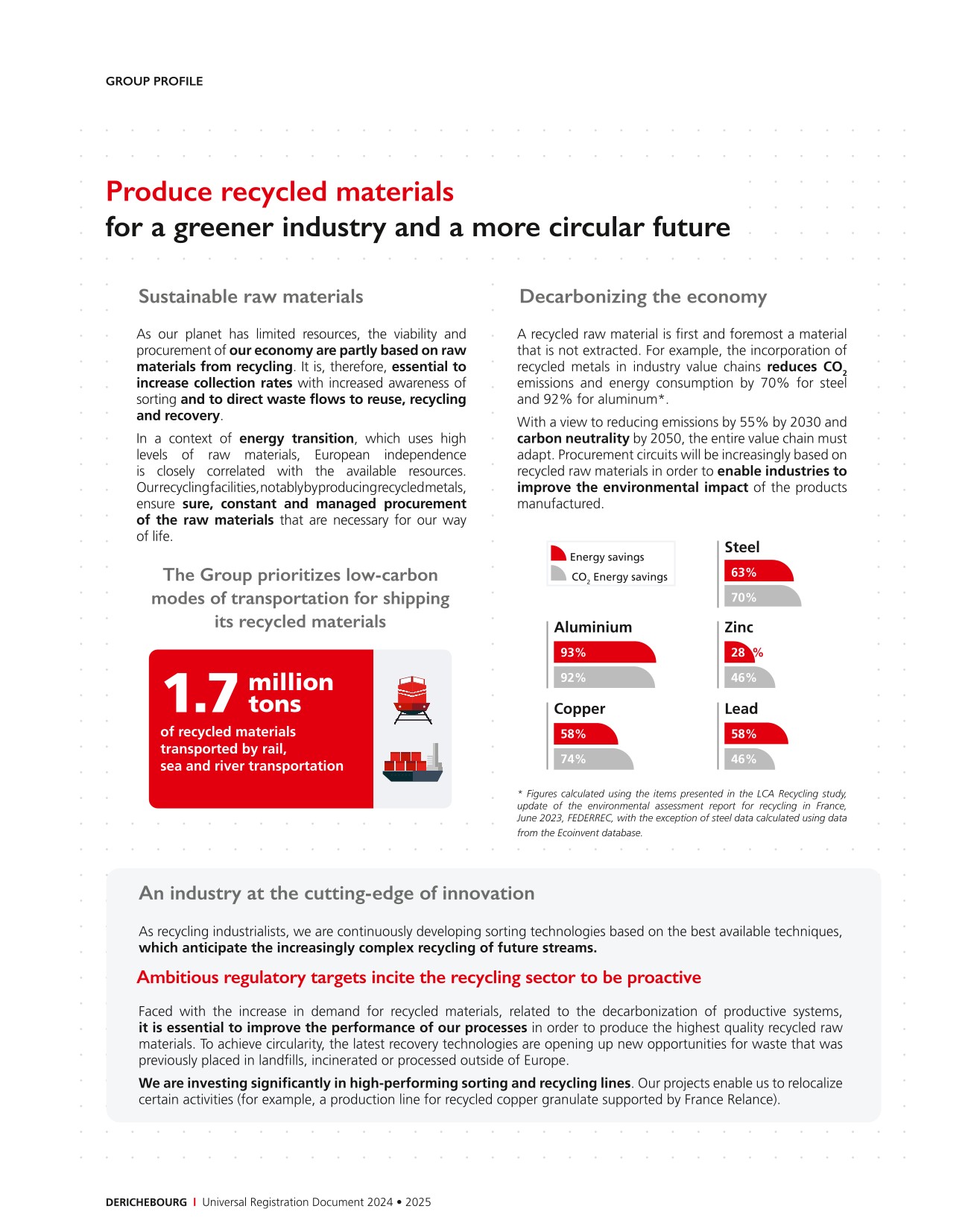
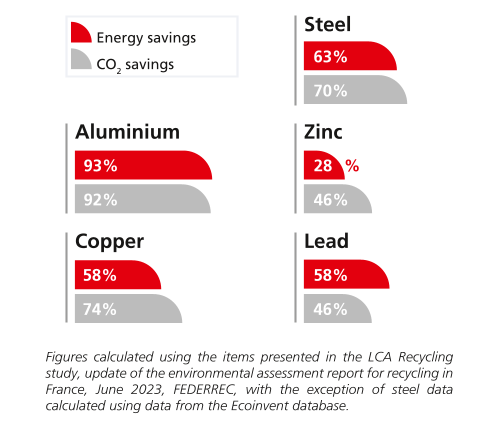
Energy savings compared to the production of primary metal are about 60% for copper and 90% for aluminum – a clear-cut competitive advantage in a context of soaring energy costs and increasingly severe restrictions on greenhouse gas emissions.
Even so, production cost savings are partially offset by the costs of collection and by environmental restrictions in industrialized nations. These limitations are less restrictive in emerging countries, which increasingly use this type of production and import recuperated products.
Recovering of end-of-life products accounts for approximately 35% of global non-ferrous metal production (source: Bureau of International Recycling). The global demand for non-ferrous metals correlates strongly with changes in the global industrial production index.
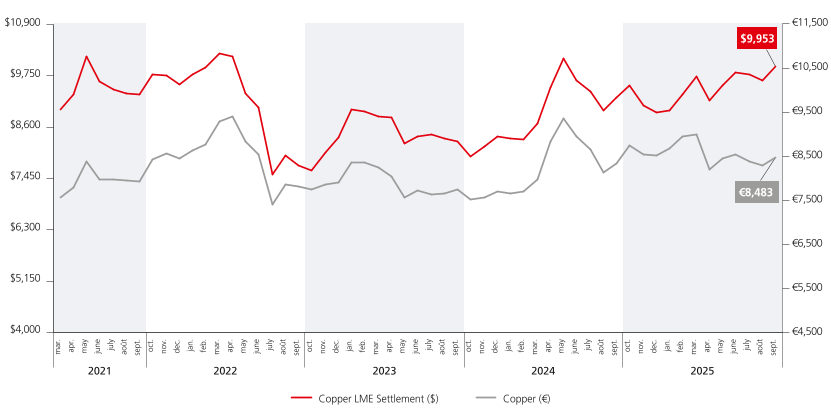
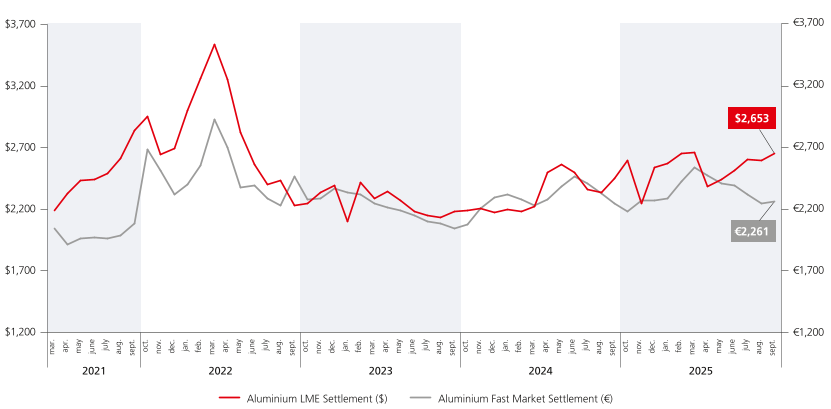
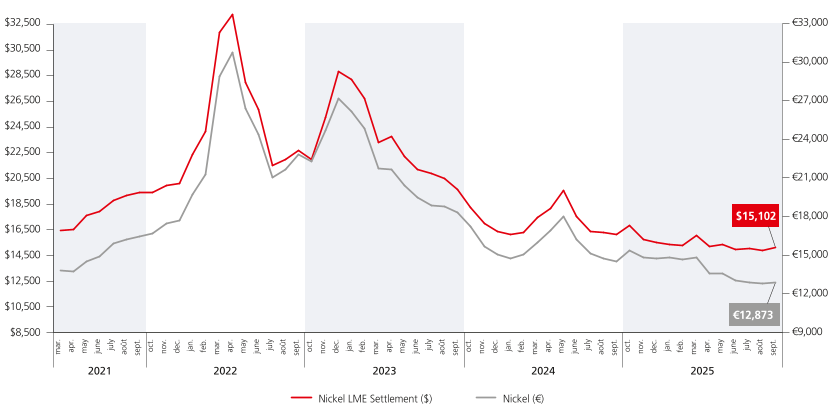
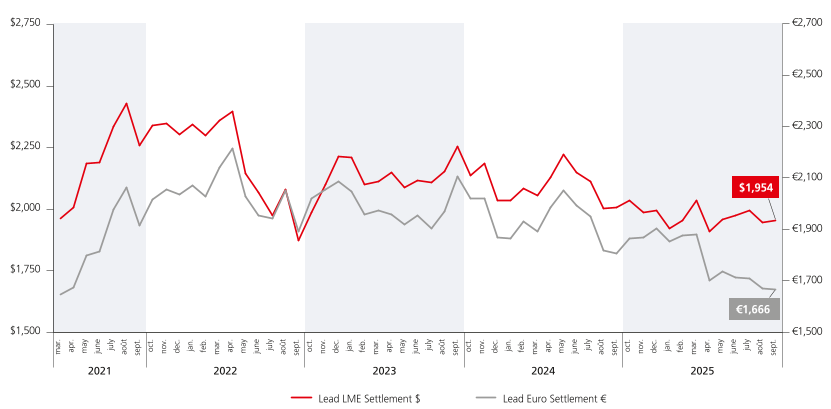
A major shift occurred in 2018, with China's decision to publish very strict specifications for impurity levels in 19 classes of products (including non-ferrous metals) in order to import them into China. These maximum rates are in practice very difficult to achieve, and the volume of Chinese imports has decreased significantly since the spring of 2018. Consequently, the volumes previously consumed by China have shifted to other markets, resulting in downward pressure on the prices of various non-ferrous metals. The increase in the prices of various non-ferrous metals, which began during the post-COVID recovery of 2021, was magnified in early 2022 with the start of the war in Ukraine and subsequent fears about metal supplies, before decreasing significantly since then due to downward economic forecasts. The graphs below summarize the price changes for various metals.
From January 1, 2021, China removed the highest grades of non-ferrous metals (especially copper granulate) from waste status and once again accepted imports of these products. However, it imports almost no solid waste now. This waste has therefore been transferred to other markets (including India, Malaysia, Vietnam, etc.).
In 2024, the European Union published a new regulation on waste exports, applicable to metals from 2027, which will modify and tighten the rules for non-OECD exports, without making them impossible.
It should be noted that these graphs, and especially those for copper and nickel, imperfectly reflect the change in the Group’s sale prices, which are based on the LME prices, but which also take into account a discount for the secondary metal. This discount changes according to market conditions. With regard to stainless steel (the majority of the value of which is made up of alloyed nickel), more and more customers are asking for prices that no longer take into account the daily evolution of nickel.
-
1.3Public Sector Services business
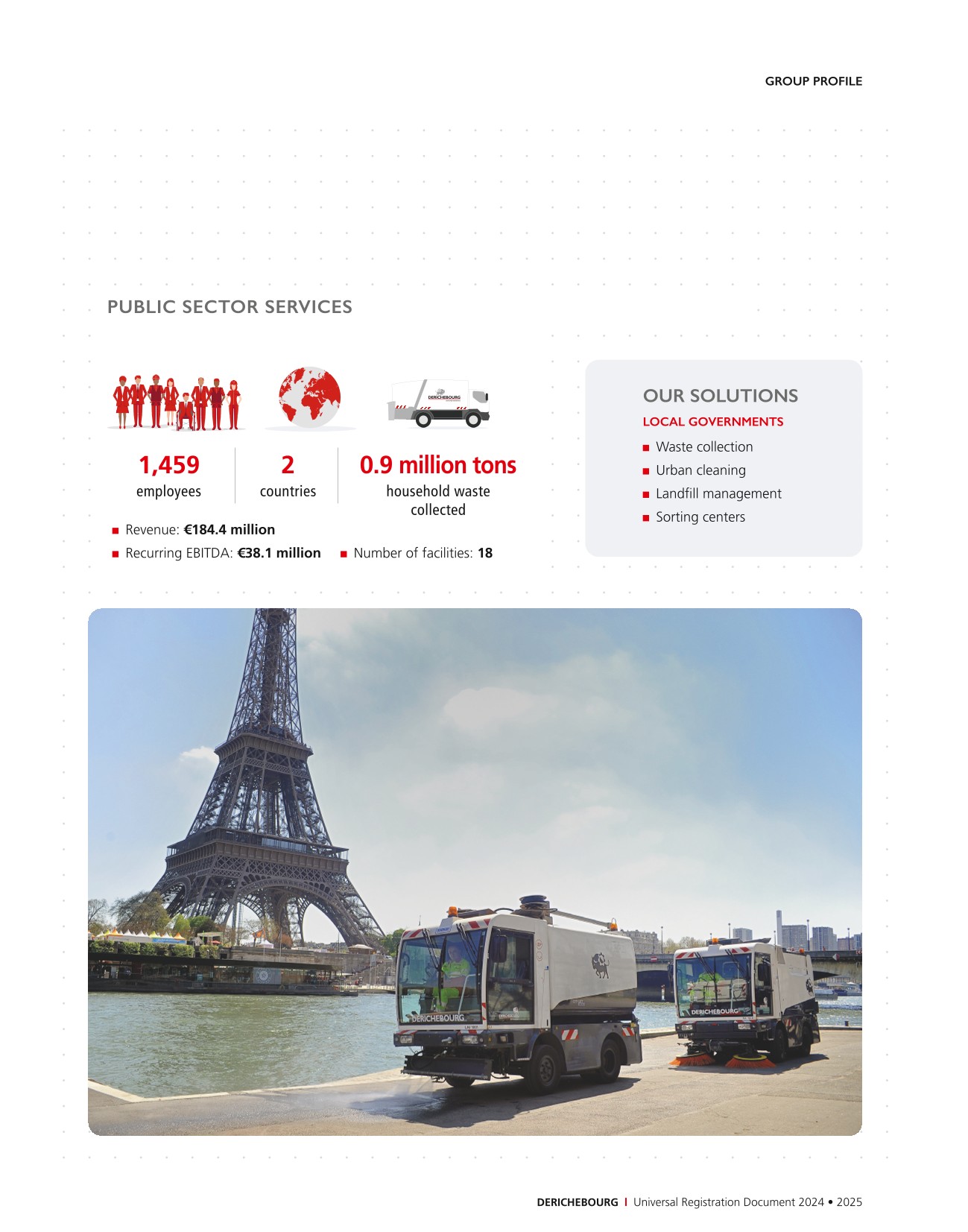
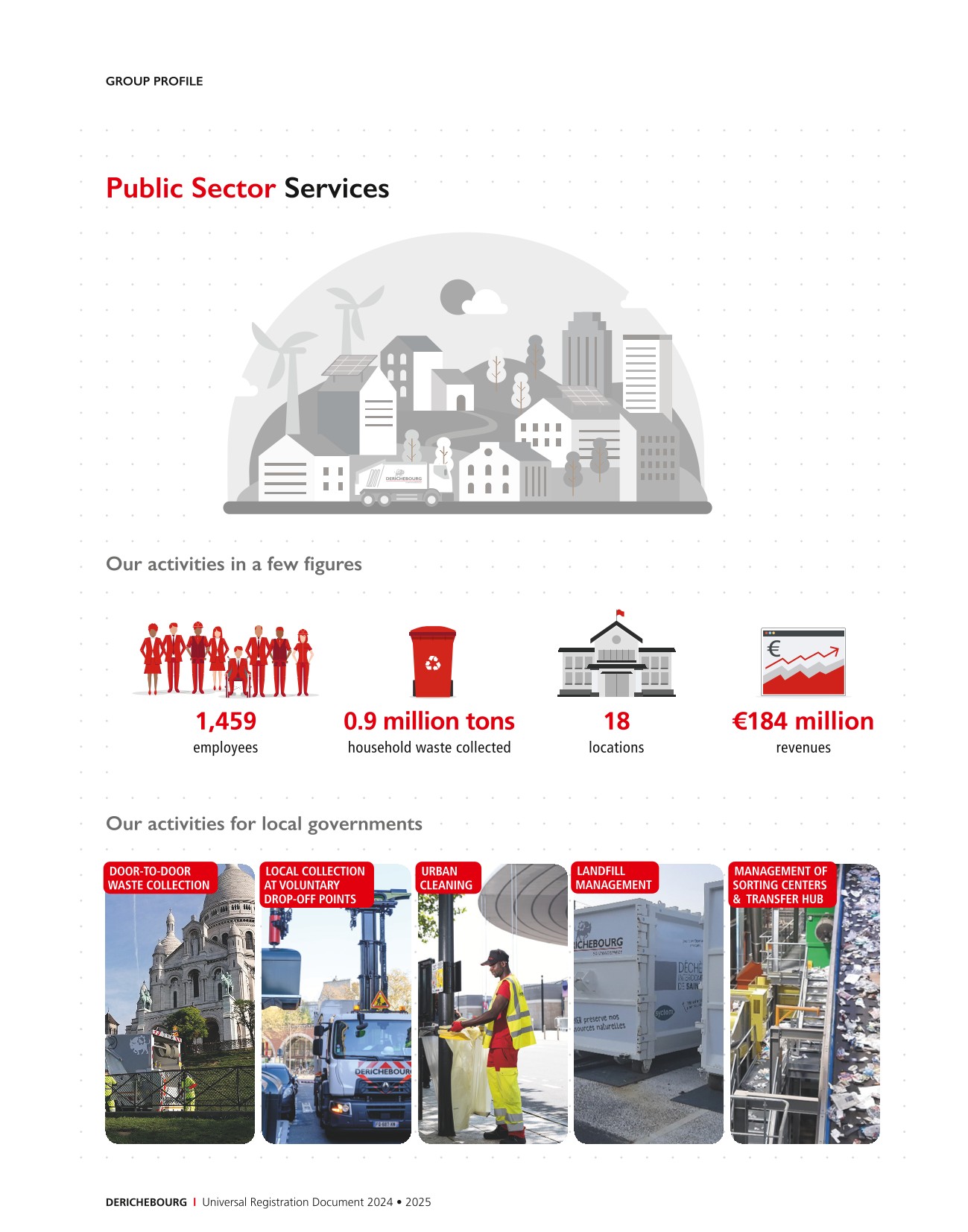
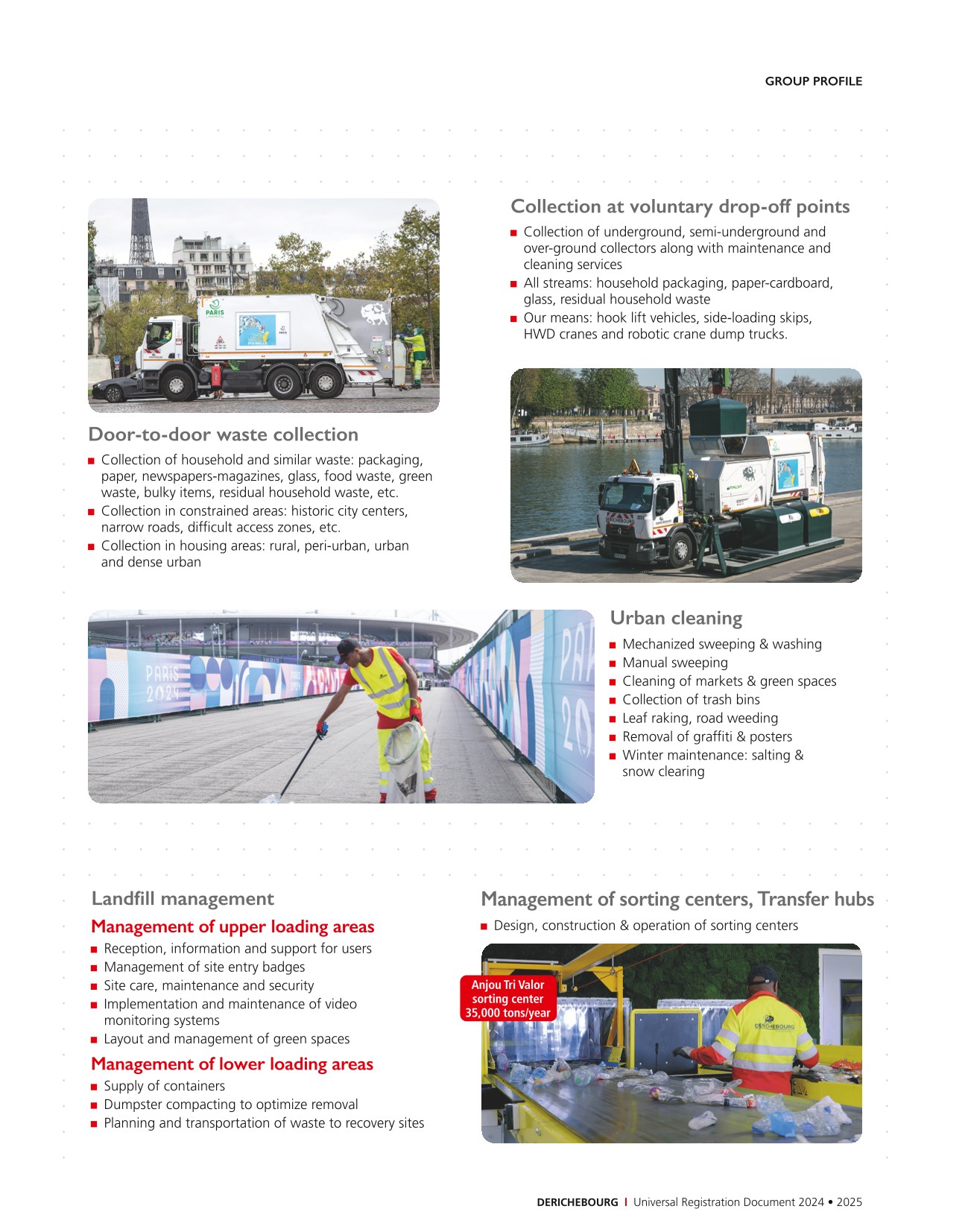
As an expert in cleaning, the Derichebourg Group offers local governments a range of services in three main areas:
- ■door-to-door waste collection and voluntary drop-off points;
- ■urban cleaning;
- ■managing recycling centers, transfer hubs and sorting centers.
The efficient management of household waste and urban cleaning is a major challenge for local governments. It determines the quality of life of citizens and the fulfillment of economic, social and environmental obligations that are an increasing burden on them. Poly-Environnement (France) and its subsidiary Derichebourg Canada collect all types of household waste (packaging, paper, cardboard, glass, green waste, food waste, bulky items, residual household waste) using all existing collection methods (door-to-door and drop-off points). These subsidiaries also manage household packaging sorting centers and transfer waste to processing and recovery centers. Lastly, Poly-Environnement offers local governments responsibility for all urban cleaning services (manual sweeping, mechanized sweeping and washing, cleaning of soiled floors, managing public bins and containers, removing graffiti, removing dumped waste, etc.).
For example, through its subsidiaries, Poly-Environnement provides door-to-door collection of household and similar waste in six of the ten districts of the city of Paris entrusted to private operators (1st, 3rd, 4th, 7th, 10th and 18th arrondissements).
Public contracts generally last for a period of five to seven years. Local authorities often request new equipment when contracts are renewed.
The Group responds to tenders that give significant weight to technical considerations, thus making it possible to highlight the quality of the service and the resources deployed by the tenderer, not only the lowest price, in order to obtain a solid return on capital employed.
The Poly-Environnement entities and its subsidiaries were historically owned by Derichebourg Multiservices, and were transferred to Derichebourg SA prior to the contribution of the Multiservices division to the Elior group in April 2023.
1.3.1The waste collection market
- ■After Germany, France is the second largest producer of household waste in Europe.
- ■In 2019, public waste management services (SPGD) collected 38.9 million metric tons of household and similar waste. In other words, each French person produces an average of 582 kg of waste per year, which places France in the European average. Since 2011, waste production per inhabitant decreased by 2%, while the overall quantity of household waste continues to increase due to the increase in the population (according to a study by ADEME on household and similar waste).
- ■Household and similar waste represents 12% of the volume of all waste produced in France, but 61.5% of public expenditure on collection and processing, i.e. €10.9 billion. The cost per inhabitant and per year is estimated at €123 according to the French Government Audit Official, including €11 for the upstream phase (prevention, communication, administration), €53 for collection, €13 for transport and €45 for processing.
- ■At the end of collection, 78% of household and similar waste is sent to a recovery channel, of which: 31% to a sorting channel, 16% to an organic recovery channel, and 32% incinerated alongside energy production.
- ■The waste collection and treatment market in France was worth €35,921 million in 2018 (source: Xerfi study), which ranks France second in Europe behind Germany (€44,270 million).
-
1.4Stake in Elior Group
Derichebourg SA holds a 48.17% stake in Elior Group, a leader in contract catering and Multiservices.
1.4.1Elior history
The Group was created in 1991 by Francis Markus, Robert Zolade and 300 executives who joined forces to acquire a 35% stake in the capital of Société Générale de Restauration, a subsidiary of the Accor group.
In 1997, the Group became the French leader in concession catering, and the following year adopted the name Elior.
In 1999, the Group decided to expand in Europe, through numerous acquisitions in the United Kingdom, Spain and Italy. A number of external growth operations were carried out in these countries during the 2000s.
In 2013, the Group entered the American market with the acquisition of TrustHouse Services, one of the leading catering companies for the education and healthcare markets in the United States. A number of new acquisitions followed in the second half of the decade, to expand the Group’s presence in this area.
In 2022, Derichebourg SA acquired a 24.36% stake in Elior Group through the purchase of shares belonging to the historical shareholder Robert Zolade and through market acquisitions.
In July 2022, Elior's management launched a strategic review aimed at improving the Company's strategic positioning and providing a solution to its high leverage ratio.
In April 2023, Derichebourg SA increased its stake to 48.31% following the contribution of the assets of its Multiservices business. The aim of the transaction is to offer strong potential for value creation, with annual synergies estimated at a minimum of €30 million by 2026. The stake was amended to 48.17% following the allocation of bonus shares in 2024.
-
1.5Strategies and objectives
1.5.1The Group's strategy in the Recycling business is "A dense network to supply specialized lines"
The Group is currently the fourth largest player in the world (and third in Europe) in terms of revenue in the recycling of metal waste, behind SIMS Ltd, EMR and TSR.
- ■consolidate our position as leading supplier in steel and metallurgy by delivering products in line with customer specifications and expanding our customer base, especially for ferrous scrap metal;
- ■implement the best sorting technologies available, so that the full added value of the various products is maintained, and reduce the share of residue headed to landfill;
- ■have a management team that implements the same strategy uniformly throughout the Group, and train employees who will be able to join the management teams of the future;
- ■update the Group's IT tools while leaving intact the main features, which make it one of the most relevant tools in the market (knowledge of inventory and real-time margins at all Group sites);
- ■expand the collection network in France and abroad by being present in each country as either a national or regional leader and explore external growth opportunities over the long term. The Group is well positioned to be a consolidator for a market at cyclical lows;
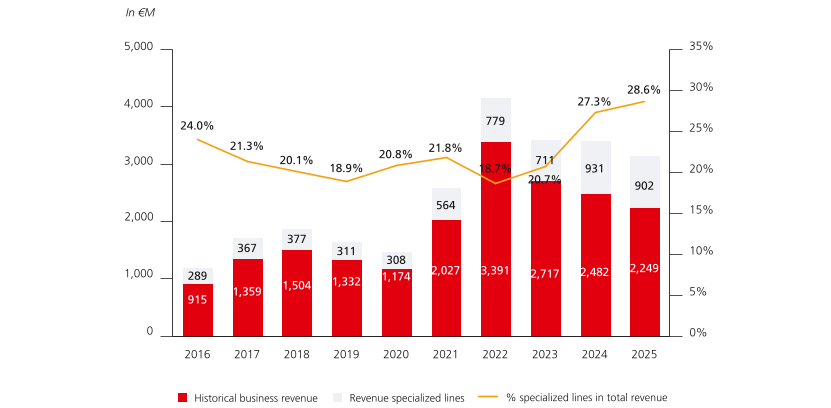
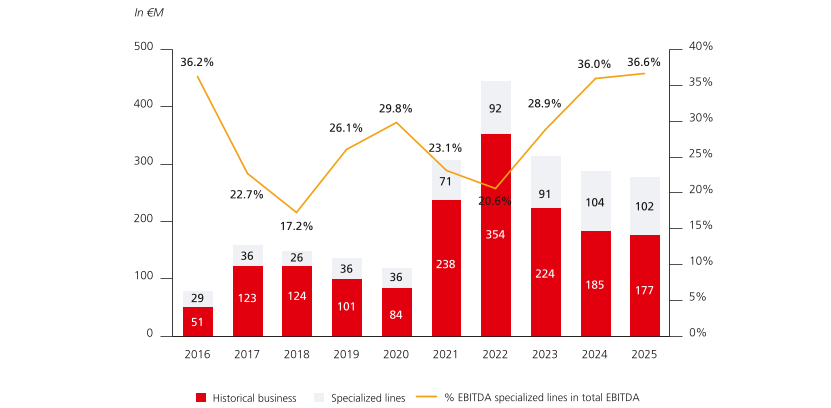
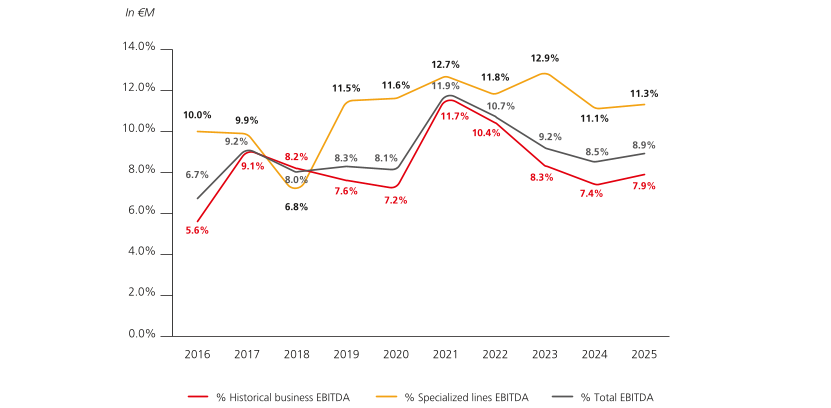
- ■develop niche businesses where there are fewer players, such as the induced heavy metals plant, aluminum or lead refining, cold preparation of mixtures for steel mills that produce stainless steel, copper cable shot-blasting and the treatment of waste electrical and electronic equipment (WEEE). The Group also seeks to develop additional sorting for the non-ferrous metals that result from the shredding process. The Group already generates more than 30% of its Recycling business revenue in these niche segments, and more than 35% of its recurring EBITDA. This percentage increases year after year as new differentiating and resilient sorting lines are started.
- The graph below illustrates the results of this strategy, which has been in place for several years.
Revenue specialized lines and historical business
EBITDA for specialized lines and historical business
% EBITDA niche and historical businesses
-
1.6Group structure
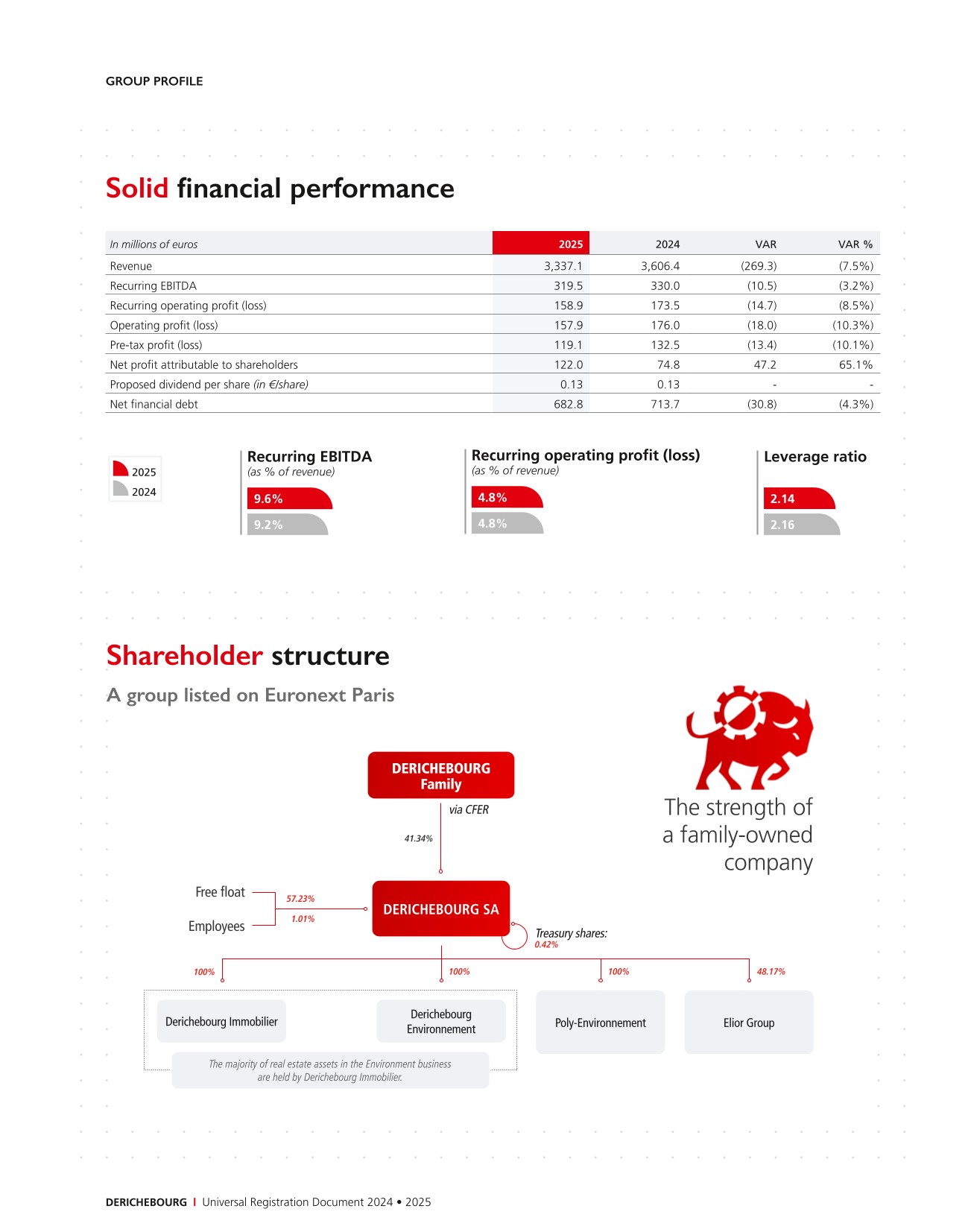
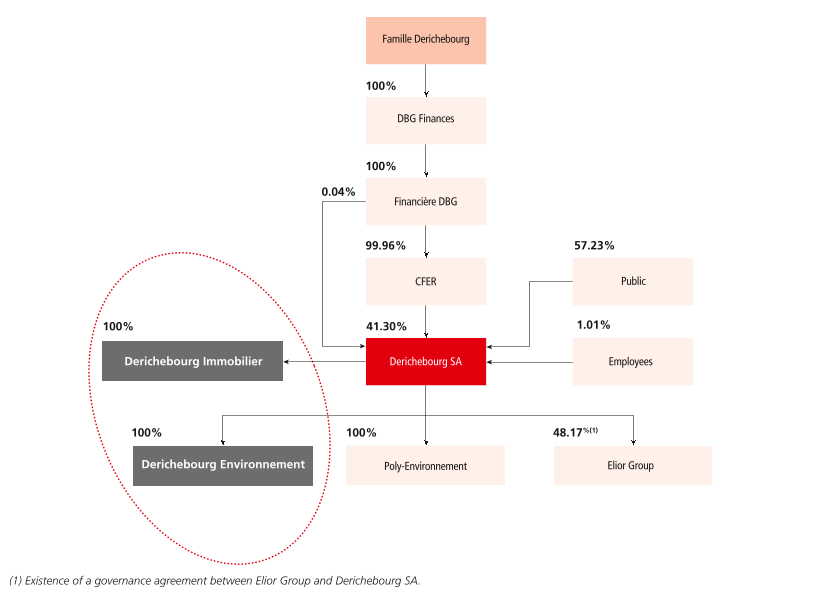
1.6.1Structure and summary organization chart of the Group and its shareholders
- ■equity interests in two parent-holding companies, Derichebourg Environnement and Poly-Environnement, which each control the operating companies in the appropriate division;
- ■shares in DBG Holding GmbH, which owns the Recycling business in Germany;
- ■shares in Derichebourg Immobilier, which holds the majority of the real estate assets of the Recycling business;
- ■a 48.17% stake in Elior Group.
The financing of the Group’s subsidiaries is provided for the most part centrally by Derichebourg, via the syndicated loan set up on March 19, 2020, for a residual amount of €90 million (see note 4.11.1.5 of the Notes to the consolidated financial statements), the Green Bond of €300 million and the EIB loan for the residual amount of €78 million.
-
2 ■ Risk factors and internal control
2.1Risk factors
2.1.1Risk analysis and monitoring process
2.1.1.1Methodology for establishing and validating the Group’s risk mapping
A mapping of the Company's general risks is updated annually. It will be updated at regular intervals by Internal Control and the Group's Chief Financial Officer, in collaboration with the operational and functional risk-bearing departments.
The risk map for 2024-2025 was presented to General Management, which validated the main risks and the implementation of the associated action plans. This mapping is presented to the Audit Committee on an annual basis.
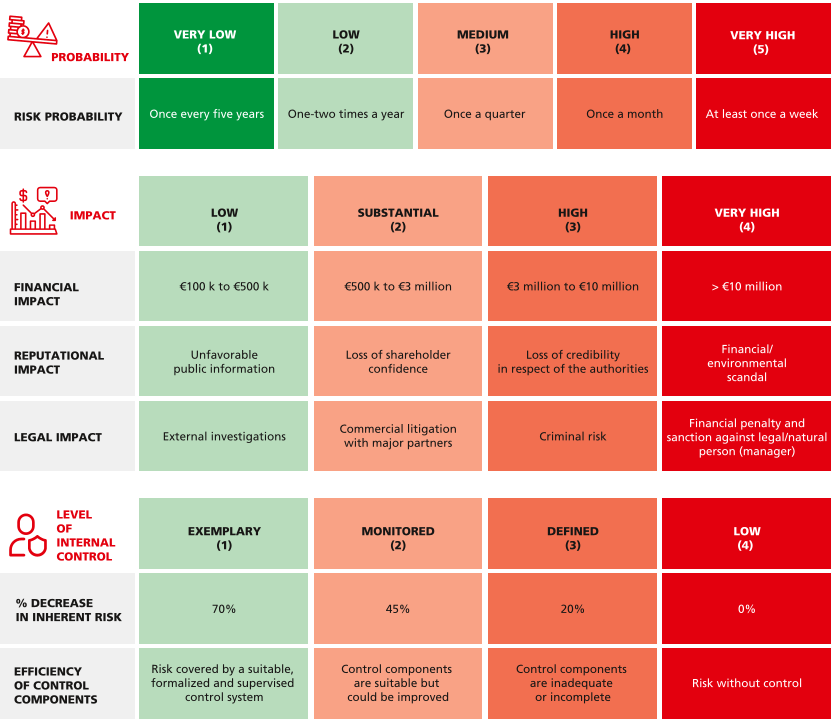
2.1.1.2Criticality matrix used
-
2.2Insurance
The Group is particularly conscious of the need to prevent risks and allocates significant resources and a considerable budget to personnel training, particularly on fire risks, site security and a range of programs covering prevention, protection, security, health and the environment.
This risk management nevertheless also includes taking out insurance policies with financially sound international insurance companies. It is the responsibility of the Group’s Insurance Department, which is managed by the parent company, to identify the risks for each business sector, establish the correct balance between insurance requirements and guarantees to be entered into, as well as the acceptable levels of policy excesses and ceilings.
This is why the decision was made, from an economy of scale perspective, to negotiate policies at the central level. Consequently, all Group entities are covered by so-called “master” insurance policies that are translated into local policies in accordance with the regulations and risks identified locally. Similarly, the Insurance Department uses “master” underwriters that act as the conduit to local underwriters in the countries where the Group operates.
In this way, the Group guarantees harmonization and an optimum level of security in its insurance policies, which it reviews whenever necessary, on the basis of information fed back by subsidiaries and claim monitoring. This takes place on at least an annual basis.
Main insurance programs
The Group's insurance policy is based on schemes that align with its activity, including the following main policies:
- ■General Public Liability Insurance: covering third-party criminal and contractual liability incurred by the Group in the event of personal injury or material and intangible damage likely to arise in the course of business operations or after delivery;
- ■Specific Public Liability Insurance for pollution risks;
- ■Property Accident Insurance: covering direct accidental and sudden material damage to the insured property. This insurance is provided by the captive reinsurance company, Derichebourg Ré;
- ■Vehicle Fleet Insurance: working from a common base, these are essentially policies adapted to the needs of local regulations;
- ■Transportation Insurance: covering claims arising from maritime, rail and ground transportation between the Group's plants and its customers;
- ■Charterer and owner's goods liability insurance, Defense and Appeal;
- ■Directors’ Liability Insurance;
- ■Workers’ Compensation Insurance, to cover work-related accidents and illness; this system is specific to the United States;
- ■Cyber/Fraud Insurance, covering extortion requests, data security, computer system availability, fraud and forgery;
- ■Credit Insurance, under the responsibility of the Group Finance Department.
-
2.3Internal control and audit
2.3.1Internal control objectives
One of the objectives of internal control is to prevent and control the risks resulting from the Company’s activity with regard to its mapping. The purpose of control procedures is to ensure that the actions of management and completion of transactions, as well as personal behavior, fall within the framework defined by the General Management guidelines.
-
3 ■ Sustainability reporting
- 3.1 General information
- 3.2 Environmental information [ESRS-E]
- 3.3 Social information [ESRS-S]
- 3.4 Information on business conduct [ESRS-G]
- 3.5 Cross-reference table between the sustainability report and other European Union legislation
- 3.6 Report on the certification of sustainability information and monitoring of the Disclosure Requirements set out in Article 8 of Regulation (EU) 2020/852 for the fiscal year ended September 30, 2025
Sustainability information is disclosed for the first time in accordance with the Corporate Sustainability Reporting Directive, known as the CSRD, which is applicable to the Derichebourg Group as a listed company. Chapter 3 contains the four parts of its sustainability report as defined in the ESRS 1 (European Sustainability Reporting Standard).
Some items are listed by reference in other sections of the URD. They are then specified by reference.
3.1General information
3.1.1Inclusion of sustainability matters
3.1.1.1General basis for preparation of the sustainability report (BP1)
Consolidation scope
The Derichebourg Group prepares this sustainability report on a consolidated basis, according to the same principles as the financial statements.
The companies sold during the fiscal year, SCEA Château Guiteronde (a winery in Bordeaux) and Derichebourg Propreté Océan Indien (DPOI) were not included because they did not make a material contribution to the various metrics over their control period.
Reporting scope – Equity method
The consolidation method used for the sustainability report is the same as for financial consolidation. As such, data from companies accounted for using the equity method is not included. However, in accordance with the ESRS standards, the share of greenhouse gas emissions of associates must be included in Scope 3 emissions. This is the case for the 48.17% stake in Elior Group. The other equity investments accounted for using the equity method were considered non-material this year.
Reporting period
Data has been collected for the calendar year ended from October 1, 2024 to September 30, 2025. If year-end data is not available, the reported period can be estimated, but still covers twelve months, in order to take into account the seasonal nature of the Company's business activity.
Option to omit specific information
The Derichebourg Group has not used the option to omit certain information relating to intellectual property, know-how or the results of innovation.
Covering the value chain
Data points (DPs) were determined through a double materiality analysis, which includes the review of impacts, risks and opportunities (IROs). This covers the upstream value chain from the waste producer and the downstream value chain as well as the processing of products sold by customers.
Equity investment within the Elior group
The Derichebourg Group holds a 48.17% stake in the Elior Group, a leader in contract catering. Elior Group's carbon emissions are presented in the climate change section of the sustainability report in proportion to Derichebourg's stake, under item 15 of the carbon audit. Although this investment is a significant asset for Derichebourg, Elior Group is an independent group that is not controlled by Derichebourg under the terms of the governance agreement, the main terms of which are set out in note 2.2.1 to the consolidated financial statements. Elior Group is not part of the Derichebourg Group's value chain, and operates completely independently in a different business sector. As Elior Group is a listed company, it is itself subject to the CSRD Directive and the reporting obligations arising therefrom. Please refer to the www.eliorgroup.com website for a detailed presentation of this information.
Data collection and control methods
The data collection and control procedures are described in section 3.1.2.5 “Risk management and internal controls over sustainability reporting.”
Formalization of policies
The Group currently has environmental and social arrangements and commitments in place. However, in all areas deemed material, these elements do not constitute formalized policies within the meaning of the ESRS requirements. The Group plans to formalize a comprehensive environmental policy within two years to address this requirement related to ESRS E1, E2 and E5. Regarding HR issues, an inventory will be carried out in 2026 in order to prioritize and manage the policies to be formalized the following year.
CSRD metric not available
Due to constraints related to our internal processes and information systems, it was not possible to publish the exact metric relating to payment terms as required by the CSRD. This information will be monitored to improve the availability and reliability of the data for future reporting cycles.
3.1.1.2Disclosures in relation to specific circumstances (BP2)
Time horizons and methodological details
Methodological details are explained throughout the report to ensure a clear understanding of the procedures used.
In accordance with ESRS 1, the time horizons considered for occurrence, both in terms of the impact materiality and financial materiality assessment, are as follows:
Sources of estimation and outcome uncertainty
The sustainability report was prepared as part of the first year of application of the Corporate Sustainability Reporting Directive (CSRD) as transposed in France by Order No. 2023-1142 of December 6, 2023 and prepared in accordance with the European Sustainability Reporting Standards (ESRS). This first year of application of the Directive was characterized by uncertainties about the interpretation of the texts and the absence of established practices.
For the 2024-2025 fiscal year, some data may be incomplete or unavailable. In this context, the Group has endeavored to apply the regulatory requirements set by the ESRS, as applicable at the date of preparation of the sustainability report, based on the information available within the preparation time frames. In some cases, metrics can be calculated by including estimated data or be subject to methodological simplifications. In these cases, the elements are mentioned in the dedicated chapters. This concerns specifically Gross Scopes 1, 2 and 3 greenhouse gas (GHG) emissions (ESRS E1-6). Some Scope 3 data is estimated or extrapolated. Greenhouse gas (GHG) emissions are estimated with a margin of error, linked to the uncertainties of the emission factors and some non-exhaustive activity data, which requires extrapolations. This is the case, for example, for the items of certain purchases of goods and services or commuting.
Changes in preparation or presentation of sustainability information
The transition from a report complying with the regulatory framework of the Extra-financial performance statement to that of the CSRD led to a restructuring of the information published under the heading of sustainability, and impacted, among other things, the metrics and indicators which the Group monitors in order to comply with the CSRD.
Reporting errors in prior periods
During the review of the data, we noted that the fuel oil consumption of one Spanish subsidiary site had not been taken into account in the carbon audit for the previous period. This consumption has been added retroactively to accurately reflect the actual emissions for the period in question. Emissions totals for this period have therefore been updated accordingly.
Disclosures from other legislation or generally accepted sustainability reporting statements
- ■the Taxonomy Regulation 2020/852/EU and the associated regulatory framework. The financial indicators for the European Taxonomy relating to the share of turnover, operating expenditure and investments aligned with sustainable economic activities are presented in section 3.2.4 "European Taxonomy";
- ■Section [GOV-4] "Statement on due diligence" of this document meets the requirements of the French Law of March 27, 2017 on the duty of care of parent companies and contracting companies. This section sets out “due diligence measures to identify risks and prevent serious violations of human rights and fundamental freedoms, the health and safety of people and the environment.”
- ■the cross-reference table with other cross-cutting and topical standards resulting from other legislative acts of the European Union (Appendix B ESRS 2) is published in section 3.5.
Disclosure requirements incorporated by reference
ESRS
Disclosure Requirement
URD chapter
URD section
2
[ESRS 2 GOV-1] The role of the administrative, management and supervisory bodies
Chapter 4 Corporate governance report
2
20. (c) the expertise and skills of the administrative, management and supervisory bodies with regard to sustainability matters or the opportunity to acquire such expertise and skills
Chapter 4 Corporate governance report
4.2 Composition of the Board
2
21. (c) the experience acquired which is relevant to the sectors, products and geographical location of the Company
Chapter 4 Corporate governance report
4.2 Composition of the Board
2
[DR GOV-1] The role of the administrative, management and supervisory bodies
Chapter 4 Corporate governance report
2
[ESRS 2 GOV-3] Integration of sustainability-related outcomes in incentive schemes
Chapter 4 Corporate governance report
4.5 Remuneration of executives and corporate officers
2
[SBM-1] Strategy, business model and value chain
Chapter 1
1.1 A global provider of recycling and public sector services
2
[ESRS 2 SBM-1-40-a-i] Description of the major groups of products and/or services offered
Chapter 1
1.2.2 Business portfolio
2
[ESRS 2 SBM-1-40-A-ii] Description of the main markets and/or groups of customers
Chapter 1
1.2.1 The recycling market
1.2.2 Business portfolio
2
[ESRS 2 SBM-1-42] Description of the business model and value chain
Introductory section
Section entitled "Group Profile" pages 6 to 15
-
3.2Environmental information [ESRS-E]
3.2.1Climate-related environmental information [ESRS E1]
3.2.1.1General information
Main risks and opportunities related to climate change and their interactions with the business model
Climate change is one of the priority material issues identified by the Derichebourg Group. The materiality analysis conducted in application of the ESRS E1 standard revealed six material IROs (impacts, risks and opportunities).
At the same time, in 2023, the Group assessed the exposure of its sites to climate hazards using different IPCC scenarios (SSP1-2.6, SSP2-4.5 and SSP5-8.5) over the 2030, 2040 and 2050 horizons. This forward-looking analysis identified the main physical risks (floods, droughts, heat waves, etc.).
The physical risks related to the effects of climate change require continuous adaptation by the Group and its customers. The transition to a low-carbon economy entails transition risks, particularly financial risks, due to the investments required to reduce the carbon footprint of facilities and assets. Transition risks therefore mainly concern the investments required to adapt the assets and logistics fleet to low-carbon technologies, as well as managing energy costs in a context of high volatility. These matters are decisive in preserving the Group's competitiveness and aligning its business model with regulatory expectations and those of its customers.
At the same time, this transition opens up potential for the Derichebourg Group, whose products and activities serve as a decarbonization lever for its customers. ADEME's Transition 2050 scenarios highlight the key role of recycling in decarbonization, with a systematic increase in the share of recycled resources in the economy. This observation illustrates the relevance and resilience of the Derichebourg Group's model, based on the supply of recycled raw materials with a low carbon footprint. This specific attribute constitutes a major opportunity, allowing the Group to contribute to the decarbonization of its customers while strengthening its attractiveness among stakeholders.
The Group's strategic approach
General approach
Increasing the share of recycled materials is a major decarbonization lever, and this role is recognized in the transition scenarios published by ADEME for the aluminum and steel sectors(1). This lever is at the core of the Derichebourg Group's business and avoids several million tons of CO2 emissions upstream in the value chain each year, thus directly contributing to the decarbonization of industrial channels.
For 70 years, the Group has been a major player in a value chain that avoids greenhouse gas emissions by melting down metals rather than by resorting to primary production via ores. As such, it has a positive societal impact, as the avoided emissions are greater than its own impact.
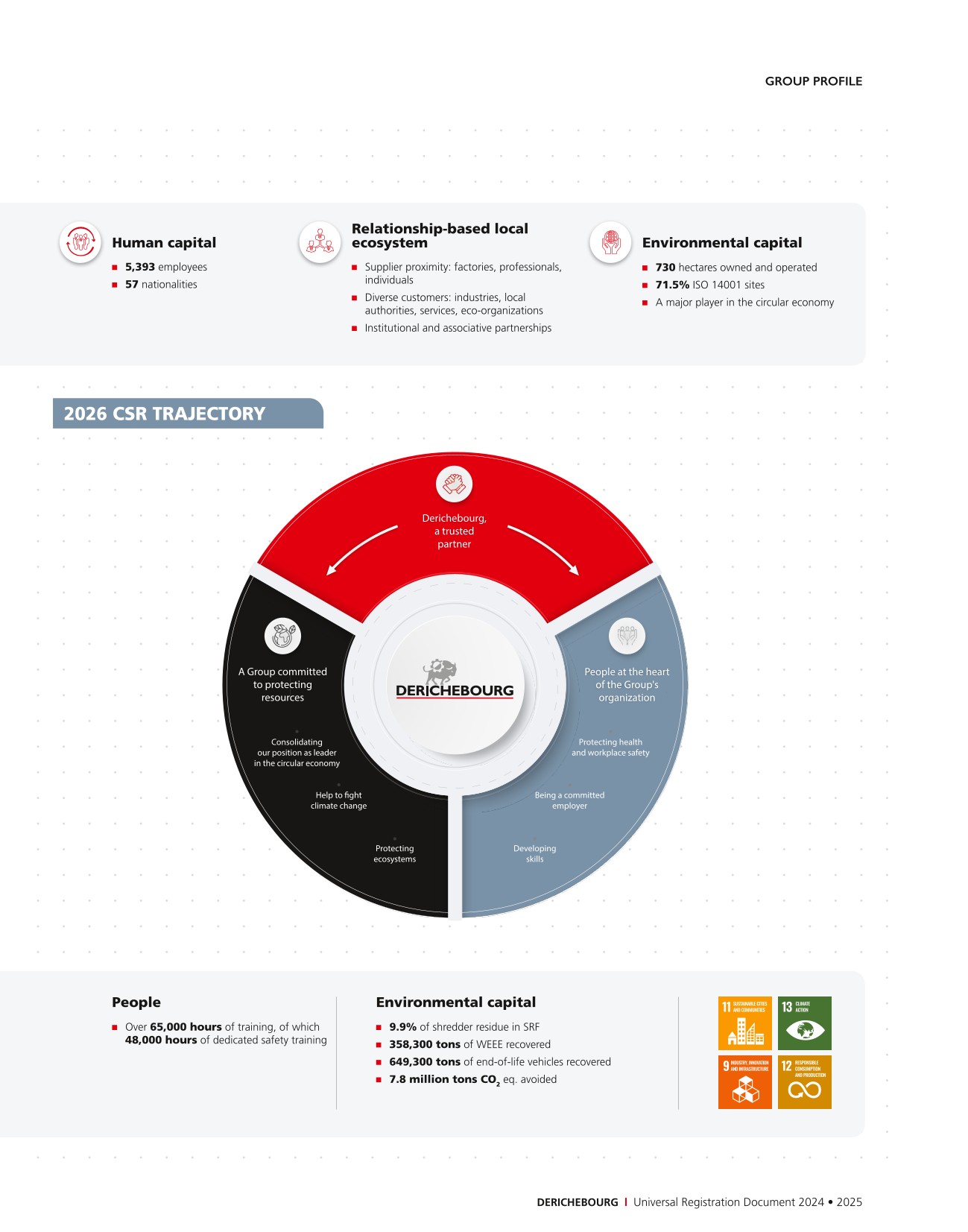
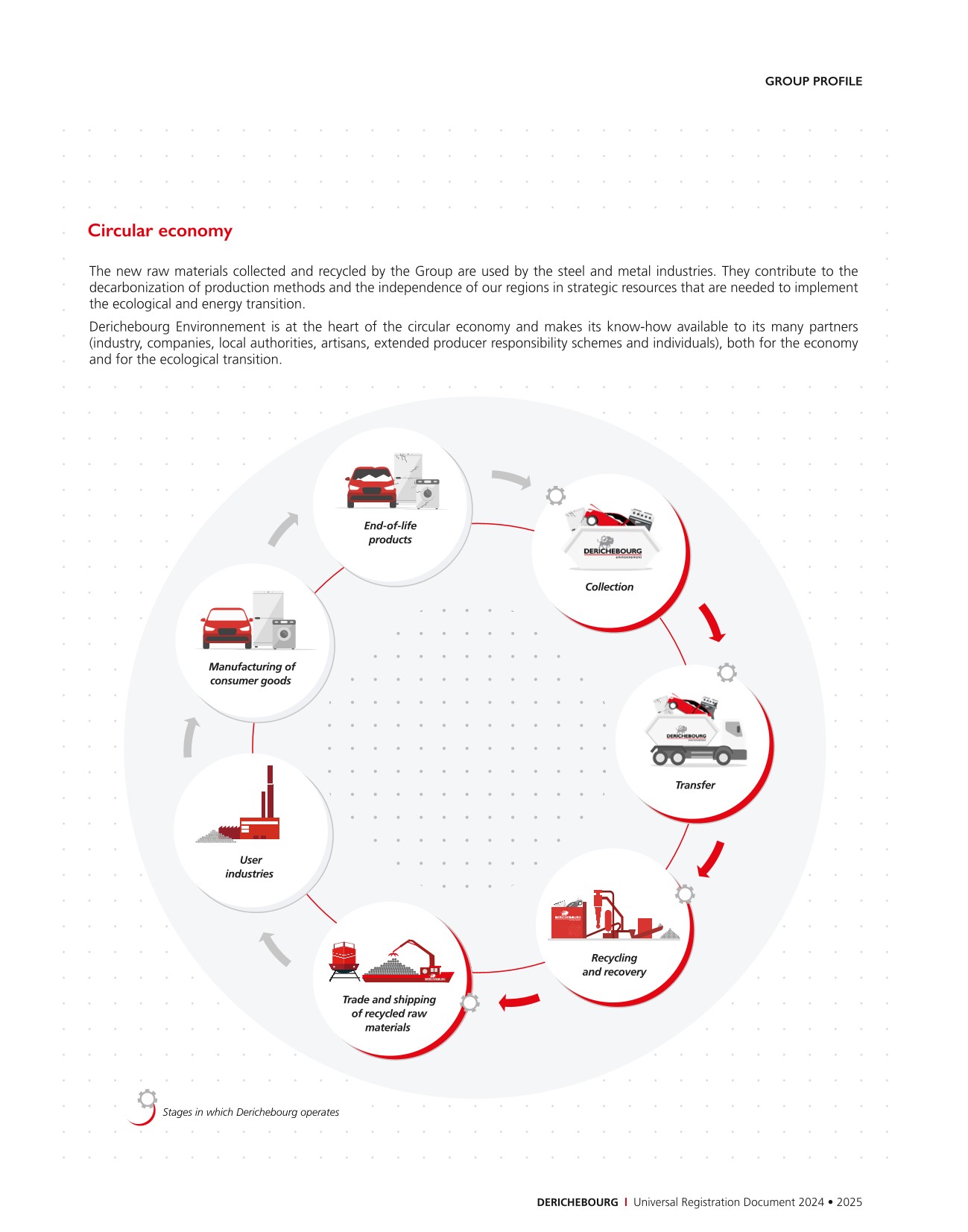
Based on this important role, the Group has made climate change an important focus of its positioning. The Company is positioned as a key player in the circular economy, capable of supporting its customers in their own decarbonization trajectories.
While the Group adopts a cautious communication approach and refrains from over-promising, this transparency is accompanied by a strong commitment to develop new recycling capacities, improve the energy efficiency of its sites, gradually electrify its machines and deploy digital tools to monitor environmental performance.
With regard to the Group's value chain, and particularly its customers, some of the decarbonization levers identified for the steel sector, such as the conversion of blast furnaces for steel production, are of little relevance to the current customer base, which is mainly composed of electric steel mills that are already carbon-efficient. The Group therefore focuses its efforts on the levers where its actions can have the most impact, in particular Scopes 1 and 2.
However, the Group remains aware of the challenges associated with this transformation. Some key technologies needed for decarbonization have not yet reached maturity, or remain prohibitively expensive for mass deployment. In addition, calculating the financials of the various transition scenarios remains complex in a context of regulatory and economic uncertainties. For this reason, in the coming years, the Group plans to run small-scale testing in order to be able to quickly deploy the most relevant solutions as soon as they are technically viable and economically sustainable.
Integration of climate performance in incentive schemes
In 2025, the Group established the strategic pillars of its decarbonization plan. New variable remuneration methods for executive corporate officers are expected to include a climate objective, in support of the Group's carbon trajectory. These terms and conditions will be submitted to the next General Meeting for approval (see section 4.1.1 "Corporate Governance Code and internal regulations").
Governance and management
General Management sets the main guidelines for the Group's carbon trajectory. The operational management of the project is carried out by the Extra-Financial Department, reporting to the Finance Department, in coordination with the QSE-CSR department, the Operations Department, the Technical Department and the operating subsidiaries to create assumptions. Once consolidated, the work is validated by General Management before being presented to the Appointments, Remuneration and CSR Committee and then to the Board of Directors. In 2025, the Group commissioned a specialized consulting firm to update its carbon footprint and formalize its decarbonization plan. The plan will be presented to the last Board of Directors meeting in 2025.
3.2.1.2Decarbonization plan (E1-1)
The fiscal year 2025 marked the first version of the Group's decarbonization plan. This sets a structured framework to guide emissions reduction efforts and strengthen the commitment to climate change mitigation.
Certain parameters, such as strategic planning horizons, financial quantification and capital allocation plans, still need to be consolidated and integrated into long-term decision-making processes.
The decarbonization plan presented below does not formally constitute a transition plan within the meaning of the ESRS. At this stage, the Group is not making any commitment to providing a transition plan.
Decarbonization levers and Trajectory 2050
Decarbonization guidelines – Scopes 1 and 2
- ■the continuation of efforts to increase energy efficiency and switch to less carbon-intensive fuels at refineries;
- ■continued efforts to improve reliability and data analysis to better manage energy consumption, in particular through discussions with suppliers (transportation) and customers;
- ■the development of eco-driving across all divisions, combined with more detailed management of consumption thanks to the deployment of on-board tools and improved data reporting from construction machinery;
- ■the gradual electrification of construction machinery and the truck fleet at the sites with the highest emissions, depending on the evolution of available technologies; the possible use of alternative fuels based on their availability and economic competitiveness;
- ■the development of renewable energy for pilot projects.
These assumptions are based on a twofold approach, combining immediate reduction efforts with the anticipation of future technological innovations to decarbonize complex industrial and logistics activities.
Decarbonization guidelines – Scope 3
In the recycling sector, raw materials consist of waste intended to be processed into secondary raw materials. This differentiating factor means that the most significant item of Scope 3 is downstream, in the processing phase of the sold products, and not in the purchases of goods and services as is the case for many other industrial sectors.
A distinctive feature of the Derichebourg Group's sales is that a significant portion is allocated to electric steel mills, which already emit fewer greenhouse gases than traditional blast furnaces. While this situation makes it possible to partially limit the downstream carbon footprint, it also reduces the potential for additional decarbonization in the short term, as the margins for progress are more limited on these production processes.
Scope 3 reduction is based on a collective effort by the sector and on the continuous improvement of the quality of emissions data, in particular by strengthening dialogue with industrial partners in order to refine assumptions and co-construct realistic reduction trajectories, as well as by refining the reliability of data relating to the use of products sold and their carbon impact. Reduction efforts similar to those modeled for the Group on its own fleet were also applied to road freight.
Objectives and projection
The Derichebourg Group has prepared a decarbonization trajectory for 2050 based on a 64% reduction in Scopes 1 and 2 greenhouse gas emissions (using the location-based approach) compared to the 2024 base year. This trajectory is based on an assumption considered to be in line with a scenario of limiting global warming to 2°C.
An intermediate target of around a 20% reduction by 2030 has also been set. However, this short-term objective remains highly dependent on the availability, maturity and cost of technological solutions to decarbonize certain operational activities.
It is an important first step in embedding climate issues at the heart of the Group's strategy. This scenario is based on a combination of internal technical and organizational efforts and the availability of suitable technological and economic solutions at scale. With this in mind, the Group is continuing to monitor technological changes and data quality improvement, and will regularly reassess its trajectory to identify opportunities for acceleration and, ultimately, move towards an ambition more aligned with limiting to below 2°C as data and technologies develop further.
The methodology used to set these objectives is based on the modeling of the main decarbonization levers in order to assess their realistic reduction potential. On this basis, the Derichebourg Group has set a final objective that is more ambitious than the results of these models in order to align its climate trajectory with a scenario compatible with limiting warming to 2°C, with the 1.5°C trajectory being deemed out of reach under current conditions.
Financial resources and reconciliation with the Taxonomy
The Company does not produce an investment plan within the meaning of the EU Taxonomy aimed at transforming economic activities eligible for the Taxonomy into activities compliant with it. However, the vast majority of its activity is considered eligible for the Taxonomy.
Actions deployed
Improving site energy efficiency and promoting less carbon-intensive energy (Scope 1)
The Derichebourg Group is pursuing a proactive approach to controlling its energy consumption, notably by obtaining ISO 50001 certification for two of its subsidiaries: Refinal Industries and Derichebourg Umwelt GmbH. Several other entities plan to take the same approach in the coming years.
The Group has implemented various actions to reduce the energy consumption of its production units. The most significant are:
- ■installing frequency converters on shredding lines to adjust the energy supply to requirements in real time;
- ■gradually replacing shredding unit motors by more energy efficient motors;
- ■acquiring four shear balers equipped with frequency converter technologies;
- ■the use of electric stationary loading cranes, a tool in which the Group is a pioneer, since it has the largest fleet in the world (85).
These initiatives contribute to improving the energy performance of our sites and reducing direct and indirect emissions related to electricity consumption.
Electrification of equipment and sites (Scope 1)
The Group's Recycling business is largely based on production units powered by electrical energy, which, in France, means that it can use an energy mix with low emissions, as nuclear energy makes up a significant share.
In 2024-2025, the Group continued the electrification of its production tools, primarily by acquiring 3 new stationary supply cranes.
In addition, the Group plans to acquire corded electric excavators for lines operated indoors, such as those dedicated to the treatment of hot water tanks and the recycling of copper cables, as well as for shredders and paper and cardboard balers. This technology reduces direct on-site carbon emissions while improving working conditions for operators by eliminating their exposure to exhaust fumes. An analysis of the fleet of production tools will also be conducted in 2026 to identify precisely where the Group has short-term opportunities to electrify its shredder, shears and balers.
Partnership for electric flexibility to benefit the French energy mix
In addition, the Derichebourg Group has continued its partnership with the company TotalEnergies for the sixth year running to achieve the ability to reduce its electricity consumption. This system, coordinated by Réseau de Transport d'Électricité (RTE), consists of temporarily reducing the consumption of industrial sites in the event of high demand on the grid. This flexibility avoids the use of CO2-intensive power plants and thus contributes to the stability and carbon performance of the French electricity system.
The Group provides nearly 26 MW of demand response capacity spread over 50 production sites, the equivalent of the electricity consumption of more than 4,300 typical French households (based on 6 kVA of power used per dwelling).
Development of renewable energies (Scope 2
As part of the "Trajectory 2026" roadmap, the objective is to reach an installed capacity of at least 2 MW by 2026. A first pilot project, at the Bonneuil-sur-Marne site, led to the installation of a 500 kW solar power plant, which will cover 25% of the site's operational energy needs. Other projects are underway, in particular at the Purfer subsidiary at the St-Pierre-de-Chandieu and Marignane sites for respective installed capacities of 340 and 118 kW. Another project was launched at Purfer's new headquarters in St-Pierre-de-Chandieu with a capacity of 87 kW. These various projects should be connected to the electricity grid in 2026.
Reducing GHG emissions from transportation (Scope 1)
Actions of the Recycling division
The Group's Recycling division has continued its efforts to optimize its transportation activity since 2018. The Company aims to provide its truck fleet with tools and procedures to monitor and optimize its fuel consumption transportation. The continuous improvement efforts relating to transportation focus on the following areas:
-
■resizing
and renewal of the fleet through:
- ■renewal of the fleet with vehicles that meet the Euro VI standard (78.7% of the fleet already compliant, excluding the United States and Mexico),
- ■selection of engines compatible with biofuels for renewals in France;
- ■deployment of on-board telematics, which can measure and control fuel consumption and therefore CO2 emissions;
- ■targeted training for drivers in France.
Since 2021, the Group has been particularly vigilant to ensure that drivers receive training dedicated to handling the new vehicles delivered (using the robotic gearbox, optimum torque, etc.), in partnership with manufacturers and body-makers (management of accessories, auxiliary crane, etc.). As a result, the driving is better adapted to the vehicles and fuel overconsumption due to poor control is avoided. The Group's transportation company, Transenvironnement, has its own team of dedicated trainers. In addition, since 2025, the French subsidiaries have been offering eco-driving training for drivers.
Optimization of routes to reduce kilometers traveled and share motor vehicles
A shared initiative is being undertaken by operating managers in the Recycling business, route planners and commercial teams in France in order to improve how collection routes are organized and motor vehicles shared to reduce the number of unnecessary kilometers driven.
Similarly, since 2016, Derichebourg works in partnership with the Michelin Group to manage its tire stock. This approach makes it possible to extend the life of tires by retreading and regrooving them, where possible, which helps to reduce the amount of raw materials consumed compared with manufacturing a new tire. The introduction of tire pressure monitoring has also helped to reduce fuel consumption.
Low-emission modes of transport (Scope 1)
For downstream transportation, the Group prioritises, where possible, maritime or inland waterway transport, which offers the most cost-effective solution and contributes to protect the environment.
The Group has access to river or maritime infrastructure for most of its subsidiaries: Bassens and Montoir-de-Bretagne (AFM Recyclage), Brussels and Ghent (Derichebourg Belgium), Houston (Derichebourg Recycling USA), Karlsruhe and Nuremberg (Derichebourg Umwelt GmbH), Mulhouse and Strasbourg (Eska), Caronte, Lyon, Saint-Romain-en-Gal (Purfer), Athis-Mons, Bonneuil-sur-Marne, Gennevilliers, Limay, Rouen and Valenciennes (Revival), etc.
The railways are also used and are an alternative to road transportation (one car for two trucks). It is less developed than water transportation, due more to structural reasons than any real desire on the Group's part.
For the 2024-2025 fiscal year, the share of tonnage transported worldwide by river and/or maritime transportation is as follows:
The modes of transportation by waterway or rail avoided the circulation of approximately 68,700 trucks over the fiscal year (based on each heavy goods vehicle transporting 25 metric tons).
Public Sector Services division actions
The Public Sector Services division remains at the clean transportation forefront of its own transportation services.
To date, more than 54% of the division's HWD fleet (France scope) runs on NGV, i.e. 219 vehicles. The PolyNormandie subsidiary has set up its own NGV distribution station for its Colombelles site (Calvados). B100-type bio-fuel (100% plant-based), made from rapeseed grown and processed in France, is also used at the Colombelles and Polyned branches (Nantes and Guérande). In total, 89 trucks use this fuel, i.e. 22% of the French fleet. The new Rennes branch is also equipped with vehicules using B100. This biofuel is also used by the Recycling business at the Gennevilliers site (Hauts-de-Seine).
Several subsidiaries have also acquired electric household waste dumpsters (6 to date), spread over the branches of Derichebourg Océan Indien, Polybuis (Gennevilliers) and Polyceja (Bobigny) for its contract for the waste collection centers in the city of Paris, and Polytensia (Rennes).
In addition, part of the HWD (household waste dumpster) fleet is equipped with Active Stop-Start™ technology. This system is designed to cut the truck's engine when it is immobile while keeping its accessories and equipment operational, such as the container lifting and dumpster compaction systems. Generally speaking, this system makes it possible to reduce greenhouse gas emissions by 30%.
3.2.1.3Energy consumption and mix (E1-5)
A detailed understanding of energy consumption and the mix used is an essential lever for reducing environmental impact. Data is collected via the Group's centralized reporting tool.
- ■fossil fuel consumption is directly derived from data reported by the Group's subsidiaries;
- ■an estimate based on a financial ratio was applied for propane used for flame cutting operations (oxygen cutting);
- ■the electricity and heat consumption purchased is monitored via contracts and invoices, or even consumption readings;
- ■The different energy sources (nuclear, fossil, etc.) of the electricity consumed are estimated based on the national energy mix of the countries of operation.
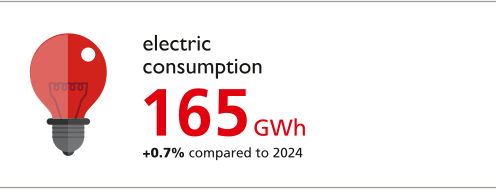
Electricity consumption was stable compared to the previous fiscal year, despite a decline in Group activity. This stability is due to the commissioning of new production lines and electrical equipment.
There has been an apparent increase in non-road diesel consumption of nearly 6%. This is mainly due to a more detailed allocation of fuels to the Hungarian, American and Italian subsidiaries. Ultimately, with a constant allocation to the previous fiscal year, there was a decrease in non-road fuel consumption, explained in particular by the decline in activity.
Gas consumption fell sharply due to the shutdown of a furnace at the Lomme refinery (Refinal Industries).
The sharp decrease in road diesel consumption is the result of several factors: a more precise distribution of fuels between the various subsidiaries with a view to improving the monitoring of our environmental consumption, the discontinuation of part of the long-distance activity of the Transenvironnement subsidiary, the closure of the Polyceo branch, as well as the increasing use of biofuels for Public Sector Services heavy goods vehicles (+150%). In addition, the Group is changing the engines of its fleet of light vehicles, gradually switching from diesel to petrol or electric. There was a slight increase in consumption of NGV used by the Public Sector Services division. This type of fuel is preferred over diesel.
Metrics E1-5 Energy consumption and energy mix
E1-5 Energy consumption and energy mix
2025
Total energy consumption
MWh
598,408
Total energy consumption from fossil sources
MWh
454,106
Nuclear energy consumption
MWh
83,605
Percentage of energy consumption from nuclear sources
%
14
Total energy consumption from renewable sources
MWh
60,697
Fuel consumption from renewable sources
MWh
9,886
Consumption of purchased or acquired electricity, heat, steam and cooling from renewable sources
MWh
50,811
Consumption of purchased or acquired electricity, heat, steam and cooling from fossil sources
MWh
30,870
Consumption of self-generated non-fuel renewable energy
MWh
0
Share of renewable energy consumed
%
10
Fuel consumption from crude oil and petroleum products
MWh
257,491
Total fuel consumption from natural gas
MWh
165,745
Share of non-renewable energy consumed
%
76
Renewable energy production
MWh
0
Total energy consumption from operations in climate-intensive sectors by revenue (1) arising from operations in climate-intensive sectors
MWh/€M
179.3
Energy consumption of your climate-intensive operations
MWh
598,408
- (1)Revenue is presented in section 5.1.2 “Group results.”
3.2.1.4GHG emissions (E1-6)
In 2025, the Group carried out a complete overhaul of its carbon footprint and has chosen 2024 as the base year, which is considered to be representative of the Group's level of activity and free of exceptional events likely to alter the observed emissions. This overhaul is part of its decarbonization plan and is based on the application of the GHG Protocol methodological framework. Emission factors are primarily taken from ADEME and the IEA. The GHG emissions presented in this report are calculated using the location-based approach in accordance with the GHG Protocol. As the Group does not currently use green electricity contracts, the emissions calculated according to the market-based approach are considered to be identical to those obtained using the location-based approach. This approach is based on the average emission factors of the energy mixes of the countries in which the Group operates, which reflects the real impact of its energy consumption on the climate.
The Group emitted 2.6 million metric tons of CO2 (Scopes 1, 2 and 3) over the 2024-2025 fiscal year. There have been some significant changes compared to previous years, explained by improved calculations, primarily due to the addition of the Tennaxia carbon accounting tool and a better comprehensiveness of the scope. These changes have allowed for a better representation of the Group's true carbon footprint.
Metric
Unit
2024
(base year)2025
Change (%)
Comments
Scope 1 – Total direct emissions
tCO2e
106,987
99,422
-7.1%
Scope 1 – fuel emissions from stationary combustion sources
tCO2e
64,457
61,557
-4.5%
Includes fuel for construction machinery, fuel used by refineries.
Scope 1 – fuel emissions from mobile combustion sources
tCO2e
42,093
37,777
-10.3%
Includes heavy and light vehicle fuels.
Scope 1 – fugitive direct emissions
tCO2e
71
76
7%
Scope 1 – direct emissions from LUCF
tCO2e
366
12
-96.7%
Scope 2 – Total
tCO2e
15,656
15,817
1%
Scope 2 - indirect emissions related to electricity consumption
tCO2e
15,608
15,781
1.1%
Based on the electricity mix of the country of operation.
Scope 2 - indirect emissions related to the consumption of other types of energy
tCO2e
48
36
-25%
Scope 3 – Overall total
tCO2e
3,250,139
2,494,940
-23.3%
Scope 3 – Total non-significant categories
tCO2e
155,388
126,255
-18.6%
Purchased goods and services, upstream fuel and energy emissions, waste generated, commuting, business travel
Scope 3 - Total significant categories
tCO2e
3,094,750
2,368,385
- 23.5%
Scope 3 – transformation of sold products
tCO2e
2,295,840
2,000,264
-12.9%
Main item, strongly related to customer processes
Scope 3 – capitalized assets
tCO2e
457,840
42,791
-90.7%
Scope 3 – downstream freight
tCO2e
222,482
252,150
13.3%
Outsourced transportation
Scope 3 – upstream freight
tCO2e
118,588
73,180
-38.3%
Outsourced transportation
Total emissions (Scopes 1+2+3)
tCO2e
3,372,782
2,610,179
- 23.6%
Change due to improved data and scope covered.
Emissions intensity in metric tons of CO2-eq according to net revenue (1)
tCO2e/€m
935.2
782.2
-19.6%
- (1)Revenue is presented in section 5.1.2 “Group results.”
Only the Scope 3 categories deemed significant over the fiscal year or base year, i.e. representing more than 5%, have been detailed in the above table.
For the significant Scope 3 categories – capitalized assets, transportation and processing of sold products – emissions are calculated from a mix of internal activity data and secondary data, without the use of data from suppliers or other direct stakeholders. Fixed assets mainly use a monetary approach with external factors, supplemented by internal physical data for certain medium-sized production equipment such as trucks, construction machinery or machine tools. Transportation (downstream and upstream) is fully quantified from distances estimated via the internal database of supplier and customer destinations, constituting internal primary activity data. The transformation of sold products combines the tonnages actually sold and technological assumptions or extrapolations for unknown customer processes. This methodological mix reflects varying precision depending on the category, and is higher for physical internal data and more uncertain when extrapolations and assumptions are used.
Certain Scope 3 categories, such as the use of sold products (Cat. 11) and the end-of-life of sold products (Cat. 12), are not included in the scope of the carbon assessment. As the Company is positioned far upstream in the value chain, it is not relevant to accurately monitor the flows and end use of materials or products after their delivery to customers. Subsequent flows and uses after metals are melted down, for example, cannot be reliably determined and are therefore not included in the emissions calculation.
In addition, the Derichebourg Group holds 48.17% of Elior Group's share capital. However, Elior Group's activities are not part of the value chain, and the Group does not exercise significant influence over the Elior Group's climate strategy or operations. The share (48.17%) of emissions published by the Elior Group for the 2024-2025 fiscal year and impacting the Group's Scope 3 amounts to 1,203,149 metric tons (according to their own reporting methodology). Combining the Scope 3 emissions of the Group's controlled entities and the share of Elior Group's emissions, the Group's Scope 3 emissions would be 3,698,089 metric tons.
Scope 1 emissions are down slightly this year. This change directly reflects the observed decrease in operations, which is reflected in the energy consumption detailed earlier in this chapter. The use of fuels has therefore naturally followed this downward trend. Emissions related to capitalized assets recorded an overall decrease, mainly due to a lower level of investment than in previous years. It should be noted, however, that 2024 was still characterized by an exceptional project – the Saint-Pierre-de-Chandieu shredder project – which represented a significant proportion of this category.
3.2.1.5Avoided GHG emissions (E1-6)
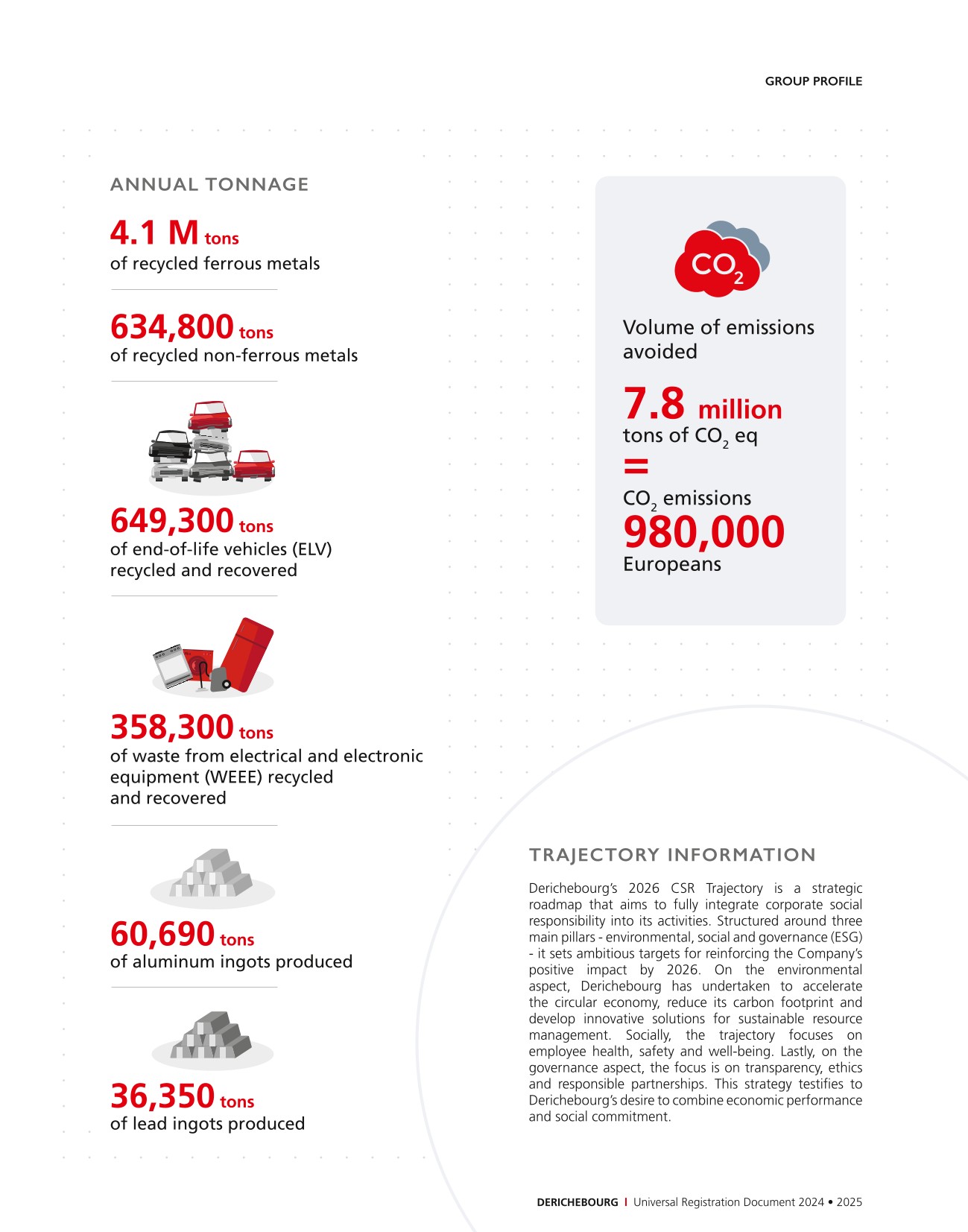
The Derichebourg Group processed 4.1 million metric tons of ferrous scrap metal and around 635,000 metric tons of non-ferrous metals.
By returning quality secondary raw materials to the marketplace, the Derichebourg Group contributes to reducing overall energy consumption. Indeed, the recycling of metals saves a significant amount of energy compared to their primary production: up to 93% for aluminum and 63% for steel.
Furthermore, the use of secondary raw materials to produce new steel or non-ferrous metals enables a significant reduction in greenhouse gas emissions compared to producing them using raw materials. Effectively, the production of one metric ton of steel from recycled materials reduces CO2 emissions by 70%, and that of a metric ton of secondary aluminum by 92%.
Moreover, the avoided emissions are underestimated because the Group does not include the avoided emissions related to the WEEE activity in its calculation. Indeed, through its processing lines for large household appliances - cold, the Group captures and processes the fluorinated gases and other greenhouse gases stored in this equipment.
The Group estimates that 7.8 million metric tons of CO2 equivalent are avoided due to its operations and those of its customers, which is the annual emissions of around 980,000 European Union inhabitants(2)
-
3.3Social information [ESRS-S]
3.3.1Disclosure Requirements
3.3.1.1General disclosure requirements and those related to the strategy [ESRS 2]
Description of the types of own workforce employees and non-employees who are likely to be significantly affected
In its double materiality analysis, the Group took into account all categories of workers, including direct employees and non-employees.
Derichebourg Group employees include all individuals who have a direct employment contract with the Company. Non-employees are those who do not have a direct employment contract with the Group, but nevertheless contribute to its operations. This particularly includes temporary workers, i.e. temporary workers hired for specific periods to meet specific labor needs. The Group has also identified occasional cases of independent professionals hired for specific assignments, and the case of brokers (specific to the Canadian waste removal and transportation services entity collection activity). These items are not published in this report due to their low number.
The majority of contracts within the Group are permanent contracts ("CDI" contracts in France) and full-time jobs. In addition, the Group's activity is intrinsically linked to its operational region, which means that these jobs cannot be off-shored.
Unless otherwise stated, the metrics are presented in number of persons at the end of the fiscal year. The employee turnover rate metric takes into account the number of departures over the entire fiscal year compared to the number of employees at the end of the year. The Group has not identified any non-guaranteed hours contracts among its workforce.
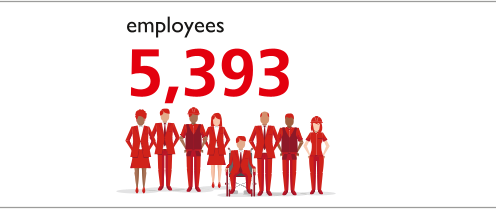
The slight decrease in workforce in 2025 (3%) is mainly due to the sale of a former Derichebourg subsidiary, Derichebourg Propreté Océan Indien, to Elior (178 people).
The geographical breakdown of employees is presented in section 3.1.3.1 "Consideration of own operations and value chain analysis" in this chapter.
Significant impacts, risks and opportunities and their interaction with strategy and business model
The Derichebourg Group is committed to respecting and promoting human rights in its activities to ensure an ethical and responsible working environment. As explained in the ESRS 2 SBM-3 and ESRS 2 IRO-1 sections presenting the double materiality analysis and its results, the Derichebourg Group recognizes that the Company's people are at the heart of the organization, and that the associated impacts, risks and opportunities are closely linked to the Company's strategy and business model.
3.3.1.2Process for interacting with the Company's workforce and its representatives (S1-2)
A significant part of the Group's business activity takes place in France. As a result, the social dialogue process meets French regulatory expectations within a broad scope regarding social dialogue and interactions with the social and economic committees (SEC).
For sites outside France, the existence of employee representation mechanisms varies and depends mainly on the size of the subsidiary. However, where such representation mechanisms exist, regular meetings are held to discuss topics identified as relevant, to sign agreements and to conduct negotiations.
3.3.1.3Processes to remediate negative impacts and channels for own workforce to raise concerns (S1-3)
Communications channels available to employees
- ■managers and HR advisors are the first channel of communication between employees and management;
- ■within the Public Sector Services business, the occasional use of social assistance in France can be a useful relay for employees wishing to report difficulties encountered;
- ■according to national legislation, health and safety issues may also be reported to the employer via bodies such as the occupational health department;
- ■the process and the whistleblower channel also provide access to report any major breach, anonymously or not. This whistleblowing system provides access to report information or any illegal or fraudulent behavior relating to a crime, misdemeanor, a threat or harm to the public interest, a violation or an attempt to conceal a violation of an international commitment ratified by France, EU law or any law or regulation, or a failure to comply with legal or internal rules of conduct.
- An internal investigation may be launched following reports received through the internal whistleblowing system or other facts identified internally (e.g. a report through the chain of command), as well as in connection with reports made to external authorities. An internal investigation is mandatory in the event of a report relating to facts likely to constitute bullying or sexual harassment. Employees are informed of the availability of this channel through poster campaigns on sites, and via the information made available on the Group's website.
-
3.4Information on business conduct [ESRS-G]
3.4.1General information
Among the important cross-functional subjects, ethics and business conduct are essential components of the Group's policy that apply to all employees, and are supported by General Management. The role of the administrative, management and supervisory bodies in business conduct is detailed in the following sections of this document (GOV-1).
The Group has identified six IROs, listed in section 3.1.4 “Double materiality analysis,” on the themes of corruption, protection of whistleblowers, influence and lobbying of public authorities and relations with suppliers.
In the case of confirmed incidents of corruption, both in the Group's own operations and through its business relations and its value chain, the Company is exposed to legal, financial and reputational penalties. The protection of whistleblowers is also an ethical issue. In the absence of dedicated systems, whistleblowers may be exposed to risks of stress, discontent or retaliation. The implementation of secure and confidential whistleblowing mechanisms helps to promote a climate of trust, encourages reports and reinforces the integrity of practices within the Group.
In a constantly changing regulatory environment, it is essential to foster a transparent dialogue with public authorities, particularly through the professional federations in which the Group participates. By sharing the specific features, constraints and challenges of the sector, particularly in terms of recycling and public sector services, the Group contributes to informing society's choices. This dialogue helps prevent the adoption of unsuitable regulations, which could lead to inappropriate obligations. This risk is all the more notable as public decision-makers sometimes have limited knowledge of the sector.
-
3.5Cross-reference table between the sustainability report and other European Union legislation
List of data points in cross-cutting and topical standards derived from other EU legislation pursuant to ESRS 2, Appendix B.
Disclosure Requirement
Data point
SFDR
Pillar 3
Benchmark Index Regulation/EU Climate Law
Chapter
ESRS 2 GOV-1
Board's gender diversity
x
x
Introductory section
ESRS 2 GOV-1
Percentage of independent directors
x
Introductory section
ESRS 2 GOV-4
Statement on due diligence
x
3.1.2
ESRS 2 SBM-1
Involvement in activities related to fossil fuel activities
x
x
x
Not applicable
ESRS 2 SBM-1
Involvement in activities related to chemical production
x
x
Not applicable
ESRS 2 SBM-1
Involvement in activities related to controversial weapons
x
x
Not applicable
ESRS 2 SBM-1
Involvement in activities related to cultivation and production of tobacco
x
Not applicable
ESRS E1-1
Transition plan to reach climate neutrality by 2050
x
x
3.2.1
ESRS E1-1
Undertakings excluded from Paris-aligned benchmarks
x
x
Not applicable
ESRS E1-4
GHG emission reduction
x
x
x
3.2.1
ESRS E1-5
Energy consumption from fossil fuels broken down by energy source
x
3.2.1
ESRS E1-5
Energy consumption and mix
x
3.2.1
ESRS E1-5
Energy intensity associated with activities in high climate-impact sectors
x
3.2.1
ESRS E1-6
Gross Scopes 1, 2, 3 and Total GHG emissions
x
x
x
3.2.1
ESRS E1-6
Gross GHG emissions intensity
x
x
x
3.2.1
ESRS E1-7
GHG removals and carbon credits
x
Not applicable
ESRS E1-9
Exposure of the benchmark portfolio to climate-related physical risks
x
Not applicable in year 1
ESRS E1-9
Disaggregation of monetary amounts by acute and chronic physical risk
x
Not applicable in year 1
ESRS E1-9
Location of significant assets exposed to a material physical risk
x
x
Not applicable in year 1
ESRS E1-9
Breakdown of the carrying value of its real estate assets by energy-efficiency classes
x
Not applicable in year 1
ESRS E1-9
Degree of exposure of the portfolio to climate-related opportunities
x
Not applicable in year 1
ESRS E2-4
Quantity of each pollutant listed in Annex II of the E-PRTR Regulation released to air, water and land
x
3.2.2
ESRS E3-1
Water and marine resources
x
Non-material
ESRS E3-1
Dedicated policy
x
Non-material
ESRS E3-1
Sustainable oceans and seas practices
x
Non-material
ESRS E3-4
Total water recycled and reused
x
Non-material
ESRS E3-4
Total water consumption in m3 per net revenue on own operations
x
Non-material
ESRS 2 SMB-3 - E4
Biodiversity sensitive areas
x
Non-material
ESRS 2 SMB-3 - E4
Impacts on land degradation, desertification or soil sealing
x
Non-material
ESRS 2 SMB-3 - E4
Threatened species
x
Non-material
ESRS E4-2
Sustainable land/agriculture practices or policies
x
Non-material
ESRS E4-2
Sustainable oceans/seas practices or policies
x
Non-material
ESRS E4-2
Policies to address deforestation
x
Non-material
ESRS E5-5
Non-recycled waste
x
3.3.3
ESRS E5-5
Hazardous waste and radioactive waste
x
3.3.3
ESRS 2 SMB-3 - S1
Risk of incidents of forced labor
x
Non-material
ESRS 2 SMB-3 - S1
Risk of incidents of child labor
x
Non-material
ESRS S1-1
Human rights policy commitments
x
3.3.6
ESRS S1-1
Due diligence policies on issues covered by the ILO Fundamental Conventions 1 to 8
x
3.3.6
ESRS S1-1
Processes and measures for preventing trafficking in human beings
x
Non-material
ESRS S1-1
Workplace accident prevention policy or management system
x
3.3.2
ESRS S1-3
Grievance/complaints handling mechanisms
x
3.4.3
ESRS S1-14
Number of fatalities and number and rate of work-related accidents
x
x
3.3.2
ESRS S1-14
Number of days lost to injuries, accidents, fatalities or illness
x
3.3.2
ESRS S1-16
Unadjusted gender pay gap
x
x
3.3.6
ESRS S1-16
Excessive CEO pay ratio
x
3.3.6
ESRS S1-17
Incidents of discrimination
x
3.3.2
ESRS S1-17
Non-respect of UNGPs on Business and Human Rights principles and OECD guidelines
x
x
3.3.6
ESRS S2 SMB-3-S2
Significant risk of child labor or forced labor in the value chain
x
Non-material
ESRS S2-1
Human rights policy commitment
x
Non-material
ESRS S2-1
Policies related to value chain workers
x
Non-material
ESRS S2-1
Non-respect of UNGPs on Business and Human Rights principles and OECD guidelines
x
x
Non-material
ESRS S2-1
Due diligence policies on issues addressed by the fundamental ILO Conventions 1 to 8
x
Non-material
ESRS S2-4
Human rights issues and incidents connected to the upstream and downstream value chain
x
Non-material
ESRS S3-1
Human rights policy commitments
x
Non-material
ESRS S3-1
Non-respect of UNGPs on Business and Human Rights, ILO principles or OECD guidelines
x
x
Non-material
ESRS S3-4
Human rights issues and incidents
x
Non-material
ESRS S4-1
Consumer and end-user policies
x
Non-material
ESRS S4-1
Non-respect of UNGPs on Business and Human Rights principles and OECD guidelines
x
x
Non-material
ESRS S4-4
Human rights issues and incidents
x
Non-material
ESRS G1-1
United Nations Convention against Corruption
x
3.4.2
ESRS G1-1
Protection of whistleblowers
x
3.4.3
ESRS G1-4
Fines for violating anti-corruption and anti-bribery laws
x
x
3.4.3
ESRS G1-4
Standards of anti-corruption and anti-bribery
x
3.4.3
-
3.6Report on the certification of sustainability information and monitoring of the Disclosure Requirements set out in Article 8 of Regulation (EU) 2020/852 for the fiscal year ended September 30, 2025
This report is issued in our capacity as Statutory Auditor of Derichebourg SA. This covers the sustainability information and information provided for in Article 8 of Regulation (EU) 2020/852 relating to the fiscal year ended September 30, 2025 and included in the Group's management report and presented in section 3 of the Universal Registration Document (hereinafter the "Sustainability Report").
Pursuant to Article L. 233-28-4 of the French Commercial Code, Derichebourg SA is required to include the aforementioned information in a separate section of its Group management report. This information has been prepared in the context of the initial application of the aforementioned articles characterized by uncertainties regarding the interpretation of the legislation, the use of significant estimates, the absence of established practices and frameworks for the double materiality analysis, as well as an evolving internal control system. It provides an understanding of the impact of the Group's activity on sustainability matters, as well as the way in which these issues influence the development of the Group's business, results and position. Sustainability matters include environmental, social and corporate governance matters.
Pursuant to Article L. 821-54 (II) of the aforementioned Code, our mission is to carry out the work necessary for issuing an opinion that expresses a limited assurance, covering:
- compliance with the requirements of the sustainability reporting standards adopted by the European Commission, pursuant to Article 29 ter of Directive (EU) 2013/34 of the European Parliament and of the Council of June 26, 2013 (hereafter ESRS for European Sustainability Reporting Standards), under the process implemented by Derichebourg SA to determine disclosures, which includes the obligation to consult the Social and Economic Committee provided for in Article L. 2312-17 (6) of the French Labor Code (assuming this applies to the entity);
- compliance of the sustainability information included in the Sustainability Report with the provisions of Article L. 233-28-4 of the French Commercial Code, including with the ESRS; and
- compliance with the information disclosure requirements set out in Article 8 of Regulation (EU) 2020/852.
We conduct this assignment in accordance with ethical rules, including independence and the quality rules set by the French Commercial Code.
It is also governed by the guidelines of the French High Audit Authority “Certification assignment for sustainability information and verification of the disclosure requirements provided for in Article 8 of Regulation (EU) 2020/852.”
In the following three separate parts of the report, for each of the area of our assignment, we present the types of verifications we have carried out, the conclusions we have drawn from them, and, in support of these conclusions, the items that we particularly focused on and the procedures we implemented in respect of these items. We draw your attention to the fact that we do not issue any findings on these items taken in isolation, and that the diligence processes described must be considered to apply generally to the findings issued on each of the three areas of our assignment.
Finally, when we feel it is necessary to draw your attention to one or more pieces of sustainability information provided by Derichebourg SA in its Group management report, we will provide an observation(s) section.
As we have been tasked with expressing limited assurance, the nature (choice of verification techniques) of the work, its scope (range) and duration fall short of those necessary to obtain reasonable assurance.
Furthermore, this assignment does not provide any guarantee on the viability or quality of Derichebourg SA's management, and does not make any assessment that would exceed compliance with ESRS information requirements on the relevance of the choices made by Derichebourg SA in terms of action plans, targets, policies, scenario analyses and transition plans.
However, it enables us to provide findings on the process of determining the sustainability disclosures, the information itself and the disclosures reported pursuant to Article 8 of Regulation (EU) 2020/852 regarding whether or not we have identified errors, omissions or inconsistencies of such importance that they could influence the decisions that may be made by readers of the information covered by our verifications.
Compliance with the requirements arising from the ESRS standards governing the process implemented by Derichebourg SA to determine the disclosures, which includes the obligation to consult the Social and Economic Committee provided for in Article L. 2312-17 (6) of the French Labor Code
- the process established and implemented by Derichebourg SA, including the obligation to consult the Social and Economic Committee provided for in Article L. 2312-17 (6) of the French Labor Code, enabled it, in accordance with the ESRS, to identify and assess its sustainability-related impacts, risks and opportunities, and to identify which of these material impacts, risks and opportunities led to the disclosure of sustainability information in the Sustainability Report; and
Based on the verifications that we carried out, we did not identify any significant errors, omissions or inconsistencies concerning the compliance of the process implemented by Derichebourg SA with the ESRS.
Below we present the items that have been the subject of particular focus by us, concerning the ESRS compliance of the process implemented by Derichebourg SA to determine the disclosures to be made.
Information relating to the identification of stakeholders is mentioned in section 3.1.3.3 "Interests and views of stakeholders (SBM-2)" of the Sustainability Report.
- stakeholders, who may affect entities within the scope of the disclosures, or may be affected by them, through their direct or indirect activities and business relationships in the value chain;
- the main users of the sustainability statements (including the main users of the financial statements).
Information relating to the identification of impacts, risks and opportunities is mentioned in section 3.1.4 "Double materiality analysis" of the Sustainability Report.
We reviewed the process implemented by the entity regarding the identification of actual or potential impacts (negative or positive), risks and opportunities ("IRO") related to the sustainability matters mentioned in Section AR 16 of the ESRS 1 standard “Application Requirements.”
We also assessed the scope used to identify the IROs, particularly in relation to the scope of the consolidated financial statements.
We took note of the mapping of the identified IROs carried out by the entity, including in particular the description of their breakdown in own operations and in the value chain, as well as their time horizon (short-, medium- or long term) and assessed its consistency with our knowledge of the Group. We examined the consistency of this mapping with the items presented to the governance bodies.
- the way in which the entity has considered the list of sustainability matters listed in the ESRS 1 standard (AR 16) in its analysis;
- the consistency of the current and potential IROs identified by the entity, as they are not covered or insufficiently covered by the ESRS standards given our knowledge of the entity.
Information relating to the assessment of impact materiality and financial materiality is mentioned in section 3.1.4 "Double materiality analysis" of the Sustainability Report.
Through interviews and inspections of available documentation, we reviewed the process for assessing the impact and financial materiality implemented by the entity, and assessed its compliance with the criteria defined by the ESRS 1 standard.
In particular, we assessed the way in which the entity has prepared and applied the information materiality criteria defined by the ESRS 1 standard, including those relating to the setting of thresholds, to determine the material disclosures in respect of the material IRO metrics identified under the relevant ESRS topical standards.
-
4 ■ Corporate governance report
- 4.1 Overview of governance
- 4.2 The Board of Directors
- 4.3 Specialized committees
- 4.4 General Management
- 4.5 Remuneration of executives and corporate officers
- 4.6 Related-party agreements
- 4.7 Executive corporate officers’ declaration concerning transactions in the Company’s shares
- 4.8 Factors likely to have an impact in the event of a public offering
- 4.9 Rules applicable to shareholder participation in General Meetings
This report was prepared in accordance with Articles L. 225-37 et seq. and L. 22-10-8 to L. 22-10-11 of the French Commercial Code and was presented to the Appointments, Remuneration and CSR Committee on December 3, 2025, then approved by the Board of Directors on December 4, 2025. In particular, it reports on the composition of the administrative and management bodies, the conditions for preparing and organizing the work of the Board, remuneration components for corporate officers and the compensation policy for corporate officers.
4.1Overview of governance
4.1.1Corporate Governance Code and internal regulations
Corporate Governance Code
The Company refers to the AFEP-MEDEF Corporate Governance Code for listed Companies as revised in December 2022. This code is available on the MEDEF website www.medef.com.
The table below shows the recommendations of the AFEP-MEDEF Code not yet applied by the Company in accordance with the “comply or explain” rule.
Code Article
AFEP-MEDEF recommendation
Implemented by Derichebourg
23
Termination of employment contract in the event of a corporate office
The Chief Executive Officer and the Deputy Chief Executive Officer have retained their previously agreed employment contracts. The new compensation policies for the Chief Executive Officer and the Deputy Chief Executive Officer, which will be put to the vote of shareholders at the Combined General Meeting of February 5, 2026, provide for the termination of these employment contracts on February 28, 2026 and the implementation of corporate office contracts.
25
Signing of a non-competition agreement with an executive corporate officer
No executive corporate officer is bound by a non-compete agreement
26.1.1
Consideration of climate targets in the remuneration of the executive corporate officers
The compensation policies for executive corporate officers proposed to the General Meeting of February 5, 2026 include a variable remuneration component linked to climate objectives.
Board of Directors' internal regulations
The running of the Company's Board of Directors is governed by internal regulations approved by the Board at its meeting on June 24, 2004 and successively modified on December 12, 2006, May 27, 2010, October 22, 2018, January 27, 2022 and November 16, 2023. The last change was made on December 4, 2025.
- ■the rules governing the composition of the Board;
- ■the Board of Directors' duties;
- ■the terms and conditions for reimbursing directors' travel expenses;
- ■the procedures for convening Board meetings;
- ■the procedures for participating in Board meetings by videoconference or teleconference;
- ■the requirements for the creation and functioning of specialized committees;
- ■the role of the Audit Committee;
- ■the role of the Appointments, Remuneration and CSR Committee;
- ■the directors' duty of confidentiality;
- ■the directors' duty of independence;
- ■the directors' duty of diligence;
- ■the scope of the internal regulations.
In addition to the duties assigned by law and the bylaws, the Board approves strategic choices, budgets, significant acquisitions and disposals, restructurings and ensures the quality and reliability of the financial and non-financial information and communications distributed to shareholders.
The internal regulations establish the rights and commitments of the directors and place particular emphasis on attendance, confidentiality of the information conveyed, the right of directors to be informed and restrictions on interventions on Derichebourg stock.
-
4.2The Board of Directors
4.2.1Rules applicable to the appointment and replacement of members
Composition of the Board of Directors (Article 14 of the bylaws)
“The Company shall be managed by a Board of Directors made up of at least three and no more than eighteen members. However, in the event of a merger, this threshold of eighteen persons may be exceeded in accordance with the requirements and limits established by the French Commercial Code.
Directors are appointed by an Ordinary General Meeting, which may dismiss them at any time. In the event of a merger or demerger, they may be appointed by an Extraordinary General Meeting. Legal entities that are appointed directors shall designate a permanent representative, who shall be subject to the same requirements and obligations as if he/she were a director in his/her own name.
An employee of the Company may be appointed as a director only if his/her employment contract is for an actual position.
The number of directors bound to the Company by an employment contract shall not exceed one third of the directors in office, barring exceptions provided for by law, particularly in the case of directors elected on the proposal of employee shareholders or directors elected by employees or appointed pursuant to Article L. 225-27-1 of the French Commercial Code."
Director(s) representing employees
In accordance with legal provisions, when the number of directors, calculated in accordance with Article L. 225-27-1-II of the French Commercial Code, is less than or equal to eight, a director representing employees shall be appointed by the Company's Social and Economic Committee.
When the number of directors, calculated in accordance with Article L. 225-27-1-II of the French Commercial Code, is greater than eight, and provided that this criterion is still met on the day of appointment, a second director representing employees is appointed in accordance with Article L. 225-27-1-III of the French Commercial Code.
In accordance with Article L. 225-28 of the French Commercial Code, directors appointed by the Social and Economic Committee must have an employment contract with the Company or one of its direct or indirect subsidiaries whose registered office is located in France for at least two years prior to their appointment.
If the number of members of the Board of Directors, calculated in accordance with Article L. 225-27-1 II of the French Commercial Code, becomes equal to or less than eight, the term of office of the second director representing employees shall continue until its expiration.
These directors are not taken into account when calculating the minimum and maximum number of directors provided for in Article L. 22-17 of the French Commercial Code, nor for the application of the first paragraph of Article L. 225-18-1 of said code.
The term of office of a director representing employees is four years. Their duties shall expire at the end of the General Shareholders' Meeting called upon to approve the financial statements for the previous fiscal year, and held in the year in which their term of office expires.
Directors representing employees shall take office at the end of the term of office of outgoing directors representing employees. Exceptionally, the first directors representing employees shall take office at the first meeting of the Board of Directors held after their appointment.
The term of office of directors representing employees ends early under the conditions provided for by law and by this Article. In particular, it shall be terminated automatically in the event of termination of the employment contract.
In the event that the role of one of the directors representing employees is vacated by death, resignation, revocation, termination of the employment contract or for any other reason whatsoever, the vacant position shall be filled by an employee appointed under the same conditions. The term of office of the director thus appointed shall end at the end of the normal term of office of the director(s) representing employees that he/she has replaced.
Subject to the provisions of the law or of this Article, directors representing employees have the same rights, are subject to the same obligations, in particular as regards confidentiality, and incur the same responsibilities as the other members of the Board.
In addition to the provisions of Articles L. 225-29, L. 22-10-6 and L. 22-10-7 of the French Commercial Code, please note that, insofar as required, a failure by the body set out by these Company bylaws to appoint a director representing employees, in accordance with the law and this Article, shall not affect the validity of the Board of Directors' decisions.
In the event that the obligation to appoint one or more directors representing employees, pursuant to L. 225-27-1 of the French Commercial Code, lapses, the term of office of the director(s) representing employees shall end upon expiration of a period of thirty days following the meeting during which the Board notes that these provisions are no longer in scope."
Term of office – age limit (Article 15 of the bylaws)
“The term of office of directors shall be four (4) years, which shall expire at the conclusion of the Ordinary General Meeting that votes on the financial statements for the previous fiscal year and that is held during the year in which the term of office expires. All directors whose term of office expires shall be eligible for reappointment. By way of exception, the Ordinary General Meeting may appoint certain directors for a term of less than four years or, as the case may be, reduce the term of office of one or more directors, in order to allow for a staggered renewal of directors' terms of office. The number of directors having reached the age of eighty (80) years shall not exceed one-third of the number of members of the Board of Directors. If this limit is reached, the oldest director shall be deemed to have resigned automatically."
Chairmanship of the Board (Article 16 of the bylaws)
“From among its members, the Board shall elect a Chairman, who shall be required to be an individual. The Chairman's term of office shall not exceed his/her term of office as director. The Board shall establish the Chairman's remuneration. The Board of Directors may dismiss the Chairman at any time. The Chairman of the Board must be less than eighty (80) years of age.
When the Chairman reaches this age, he/she shall be deemed to have resigned automatically. However, his/her term of office is extended until the next meeting of the Board of Directors, at which his/her successor will be appointed.
The Chairman of the Board of Directors shall organize and manage the work of the Board of Directors, and report thereon to the General Meeting. The Chairman shall ensure the proper operation of the Company's governing bodies and, in particular, shall ensure that the directors are capable of performing their duties. If it deems necessary, the Board may appoint one or more Vice-Chairmen, whose duties shall consist exclusively of chairing Board meetings and General Meetings in the absence of the Chairman.
In the absence of the Chairman and of the Vice-Chairmen, the Board shall designate a director present to chair its meeting. At each meeting, the Board may appoint a secretary, who shall not be required to be a shareholder."
Succession plan
Pursuant to the provisions of Article 18.2.2 of the AFEP-MEDEF Code as revised in December 2022, the Appointments, Remuneration and CSR Committee, at its meeting of December 4, 2024, established the succession plan for executive corporate officers.
Staggered terms of office
In order to allow for staggered renewal of the terms of office of directors, and to comply with the provisions of Article 15.2 of the AFEP-MEDEF Code, the Combined General Meeting of January 31, 2023, in its 24th resolution, amended Article 15 of the bylaws authorizing the Company's shareholders to appoint certain directors for terms of less than four years.
It is therefore proposed that the Combined General Meeting of February 5, 2026 renew four directors' terms of office for different terms, thus allowing for staggered terms of office and avoiding the block reappointment of all directors.
Directors' selection process
The directors' selection process is formally incorporated into the internal regulations of the Appointments, Remuneration and CSR Committee, which organizes this selection in such a way as to try to achieve balance in the composition of the Board of Directors.
During the 2024-2025 fiscal year, this procedure was implemented when Ms. Catherine Claverie's term of office as director was renewed.
-
4.3Specialized committees
The Board of Directors decided to set up two specialized committees: the Audit Committee and the Appointments, Remuneration and CSR Committee.
Each committee has its own internal regulations that set out its composition, duties and operating procedures.
The committees examine and prepare certain decisions of the Board of Directors. They issue opinions and recommendations in their area of expertise and report on their work to the Board of Directors.
The composition of the committees is decided by the Board of Directors and may be amended at any time by decision of the latter.
4.3.1Audit Committee
The Board is assisted by an Audit Committee composed of four directors, of whom three are independent directors:
- ■Mr. René Dangel, Independent Director, Chairman;
- ■Ms. Françoise Mahiou, Independent Director;
- ■Ms. Catherine Claverie, Independent Director;
- ■Mr. Boris Derichebourg, Director.
This composition complies with the threshold of two-thirds of independent directors as recommended by the AFEP-MEDEF Code.
At the request of the Committee members, executive corporate officers may be invited to attend committee meetings as guests, depending on the issues examined.
During these meetings, the Audit Committee regularly calls on the CSR Manager, the IT Director and the Internal Control Manager, depending on the issues examined.
The Audit Committee may also use external technical studies. The members of the Committee did not consider it necessary to use this option during this fiscal year.
The Audit Committee fulfills the duties assigned to it in Article L. 821-67 of the French Commercial Code. The Audit Committee oversees matters relating to the preparation and auditing of accounting and financial information, in particular:
- ■the preparation and disclosure of financial information, in particular through examination of the scope of consolidated companies;
- ■the effectiveness of the internal control and risk management systems, their deployment and the implementation of corrective actions where appropriate;
- ■the audit of annual financial statements and, if applicable, of consolidated financial statements by the Statutory Auditors;
- ■the skills and independence of the external experts on which the Group relies.
- ■examine the scope of consolidation and the draft consolidated and separate financial statements and related reports that will be submitted to the Board of Directors for approval, the accounting methods adopted for the preparation of consolidated or separate financial statements, as well as the appropriate treatment of significant transactions at the Group level;
- ■oversee the choice of the consolidation guidelines, the relevance and permanence of the accounting methods adopted for the preparation of the consolidated or separate financial statements, as well as the appropriate treatment of significant transactions at the Group level;
- ■verify with General Management that all legal and financial communications with the stock market authorities are duly completed;
- ■assess the degree of satisfaction of the Statutory Auditors with the quality of the information received from the Company’s departments in the performance of their assignment and gather Management’s comments on the degree of sensitivity of the Statutory Auditors to the Group’s business and its environment;
- ■examine any information brought to its attention concerning the operations and transactions of the Company that raise an ethical problem and with regard to transactions that, depending on their nature and the person involved, would result in a conflict of interest;
- ■ensure that major risks are identified, managed, and reported to it. To this end, it examines the internal control and risk management systems and internal audit program, monitors its progress and the results of the action plans, and informs the Board of improvements that have been or have yet to be made;
- ■give an opinion on the appointment or renewal of the Statutory Auditors;
- ■ensure the independence and objectivity of the Statutory Auditors.
During the past fiscal year, it held two meetings, on December 4, 2024 and May 26, 2025, with an attendance rate of 100%.
Meeting of December 4, 2024
- ■Review of the consolidated financial statements at September 30, 2024.
- ■Statutory Auditors' supplementary report to the Audit Committee.
- ■Advice and recommendations by the Audit Committee to the Board of Directors on the draft Universal Registration Document 2023-2024.
- ■Review of the Statutory Auditors' terms of office; opinion and recommendation of the Audit Committee on the renewal of a term of office.
- ■Proposal for the appointment of a Statutory Auditor responsible for certifying the sustainability information; opinion and recommendation to the Board of Directors on the proposed appointment.
- ■Presentation of the responses provided to the High Committee on Corporate Governance and the French Financial Markets Authority on August 31 and September 2, 2024.
- ■Monitoring of cybersecurity action plans; presentation of the Intrinsec audit report.
- ■Presentation of the internal audit charter and the internal audit plan.
- ■Presentation of the Group risk mapping for 2024.
- ■Update on AFA (French Anti-Corruption Agency) monitoring.
- ■Update on ongoing litigation.
Meeting of May 26, 2025
- ■Review of the half-year consolidated financial statements as of March 31, 2025.
- ■Review of off-balance sheet commitments.
- ■Presentation of the Statutory Auditors' conclusions on the half-year consolidated financial statements as of March 31, 2025.
- ■Opinion and recommendations to the Board of Directors on the half-year consolidated financial statements as of March 31, 2025.
- ■Internal audit: monitoring of the internal audit plan, main findings following the missions carried out, and follow-up of recommendations including the cybersecurity audit.
-
4.4General Management
4.4.1Chief Executive Officer (non-director)
Mr. Abderrahmane El Aoufir, aged 64, of French nationality, holds a Master’s degree in economics – management option from the University of Clermont-Ferrand. He began his career in 1984 in the Finance Department of Compagnie Française des Ferrailles. He successively held operational and then general management positions in Spain, the United States and southeastern France. In 2006, Mr. Daniel Derichebourg entrusted him with the task of turning around Servisair, the airport services subsidiary, and in six years he managed to increase EBITDA from €5 million to €73 million. After the sale of Servisair in December 2013, Mr. Abderrahmane El Aoufir became Deputy Chief Executive Officer of the Group. He also oversees the operational activities of the recycling subsidiaries.
Mr. Abderrahmane El Aoufir was appointed as Chief Executive Officer by the Board of Directors on April 18, 2023 for the duration of the term of office of the Chairman of the Board of Directors, i.e. until the end of the Annual General Meeting called to approve the financial statements for the fiscal year ending on September 30, 2025.
Offices and/or positions held in another company (within and outside the Group) during the course of the fiscal year ended September 30, 2025
Chairman and Chief Executive Officer
GUY DAUPHIN ENVIRONNEMENT
Chairman
BARTIN RECYCLING
DERICHEBOURG ENVIRONNEMENT
DERICHEBOURG EXPANSION
IRON HORSE HOLDING
IRON HORSE FRANCE
POLY-ENVIRONNEMENT
TRANSENVIRONNEMENT
Chief Executive Officer
DERICHEBOURG VALORISATION
FRICOM RECYCLING
Director
AFM RECYCLAGE
FRICOM RECYCLING
GUY DAUPHIN ENVIRONNEMENT
Manager
SCI DERICHEBOURG IMMOBILIER
SCI LA GARONNE
Permanent representative
ELIOR GROUP (1) (DERICHEBOURG)
Legal representative
GDE CO 1 (IRON HORSE HOLDING)
GDE CO 2 (IRON HORSE HOLDING)
SCI LA PETITE MOUÉE (IRON HORSE FRANCE)
Chairman abroad
DERICHEBOURG ESPAÑA, S.A.
LOCA
Director abroad
IRON HORSE BV
Manager abroad
DERICHEBOURG UMWELT GmbH
Director abroad
CRS
DERICHEBOURG RÉ
ECORE BELGIUM
ECORE LUXEMBOURG
DERICHEBOURG RECYCLING MEXICO
DERICHEBOURG RECYCLING USA, INC.
ECORE TRANSPORT LUXEMBOURG
- (1)Listed company.
Other offices held during the last five years
Chairman and Chief Executive Officer
REVIVAL EXPANSION
Chairman
VALRECY
REFINAL INDUSTRIES
FRICOM RECYCLING
VALME TECHNOLOGIES
INOREC
Chief Executive Officer
DERICHEBOURG ENVIRONNEMENT
Deputy Chief Executive Officer
DERICHEBOURG (1)
Member of the Management Board
GUY DAUPHIN ENVIRONNEMENT
Director
REVIVAL EXPANSION
Chairman abroad
REYFRA
Director abroad
DERICHEBOURG MEDIO AMBIENTE SA
ENNINGDAL HOLDING BV
REYFRA
SELMAR SA
Director abroad
ECORE BV
- (1)Listed company.
-
4.5Remuneration of executives and corporate officers
4.5.1Compensation policy for corporate officers submitted for approval to the Combined General Meeting of February 5, 2026 (Article L. 22-10-8 of the French Commercial Code)
In accordance with the provisions of Article L. 22-10-8 of the French Commercial Code, the Board of Directors, based on the proposal of the Appointments, Remuneration and CSR Committee meeting on December 3, 2025, will submit the new compensation policy for executive and non-executive corporate officers for the 2025-2026 fiscal year for the approval of the Combined General Meeting of February 5, 2026.
The previous compensation policy applicable to corporate officers was adopted by the Combined General Meeting of January 29, 2025.
The Board of Directors sets out, reviews and implements the compensation policy for each of the corporate officers at the recommendation of the Appointments, Remuneration and CSR Committee.
In accordance with the provisions of Articles L. 22-10-8 and R. 22-10-14 of the French Commercial Code, the Board sets a compensation policy in line with the Company's corporate interest, which contributes to its sustainability and is in line with its commercial strategy.
In order to avoid any conflict of interest, the Chairman, the Chief Executive Officer and the Deputy Chief Executive Officer do not take part in discussions or votes on remuneration and any commitments relating thereto.
It should be noted that, in respect of the fiscal year just ended and pursuant to Article L. 22-10-8 of the French Commercial Code, the principles and criteria for determining, allocating and awarding the fixed, variable and exceptional components of the total remuneration and benefits of any kind to executive corporate officers in respect of their office were approved by the Combined General Meeting of January 29, 2025 under the specific resolutions relating to the Chairman of the Board of Directors, the Chief Executive Officer and the Deputy Chief Executive Officer. The new compensation policy, which will be submitted for approval to the Combined General Meeting of February 5, 2026, makes changes to the one previously voted on.
4.5.1.1Compensation policy for the members of the Board of Directors submitted for approval to the Combined General Meeting of February 5, 2026
The directors receive a fixed remuneration linked to their activity, the maximum total amount of which is approved at the Ordinary General Meeting.
The Combined General Meeting of January 30, 2024 set the remuneration of the members of the Board at the annual sum of €375,000 as of the 2023-2024 fiscal year, and for each of the following fiscal years until a further decision is made.
On November 16, 2023, the Board of Directors decided to allocate a fixed portion of 25% of the remuneration allocated to directors and a variable portion of 75% based on the attendance of members at Board and committee meetings to which they are invited. This variable portion will be paid if the attendance rate is at least 66%.
The distribution of the directors’ remuneration, within the limit of the total maximum amount approved at the General Meeting, is decided by the Board of Directors. At its meeting of May 27, 2025, the Board of Directors decided to distribute this amount among the various directors.
It is specified that the director representing employees receives remuneration as a Director determined according to the same conditions as the other directors. He also has an open-ended employment contract with the Company with notice and termination conditions in accordance with regulations, and receives remuneration thereunder.
4.5.1.2Compensation policy for Mr. Daniel Derichebourg, Chairman of the Board of Directors, submitted for approval to the Combined General Meeting of February 5, 2026
The components of the remuneration of the Chairman of the Board of Directors were reviewed, examined, discussed and decided by the Appointments, Remuneration and CSR Committee on December 3, 2025, and by the Board of Directors meeting of December 4, 2025, in connection with the compensation policy set by the Board of Directors to be submitted to the shareholders' vote on February 5, 2026.
In accordance with the provisions of Article L. 22-10-34 of the French Commercial Code, the Combined General Meeting of February 5, 2026 will be called to approve the components of the remuneration paid or awarded to Mr. Daniel Derichebourg for the fiscal year ended September 30, 2025, as presented in this report.
The current compensation policy for the Chairman of the Board of Directors described below was approved by the Combined General Meeting of January 29, 2025.
Remuneration of the corporate office
Mr. Daniel Derichebourg does not receive any remuneration in respect of his position as Chairman of the Board of Directors of Derichebourg.
Employment contract
Mr. Daniel Derichebourg has no employment contract with Derichebourg or any company controlled by the latter.
Benefits in kind
Mr. Daniel Derichebourg does not receive any performance shares, stock options or purchase options from the Company or any company it controls.
Social benefits and insurance
Compensation policy for the 2025-2026 fiscal year submitted to the Combined General Meeting of February 5, 2026
On December 4, 2025, the Board of Directors decided to maintain the compensation policy for the Chairman of the Board of Directors unchanged for the 2025-2026 fiscal year.
4.5.1.3Compensation policy for Mr. Abderrahmane El Aoufir, Chief Executive Officer, submitted for approval to the Combined General Meeting of February 5, 2026
The components of the remuneration of the Chief Executive Officer were reviewed, examined, discussed and decided by the Appointments, Remuneration and CSR Committee on December 3, 2025, and by the Board of Directors meeting of December 4, 2025, in connection with the compensation policy set by the Board of Directors to be submitted to the shareholders' vote on February 5, 2026.
The current compensation policy for the Chief Executive Officer, described below, was approved by the Combined General Meeting of January 29, 2025.
Remuneration of the corporate office
Mr. Abderrahmane El Aoufir does not receive any remuneration in respect of his position as Chief Executive Officer of Derichebourg.
Employment contract
Mr. Abderrahmane El Aoufir receives remuneration paid to him by Purfer under an employment contract.
The fixed remuneration of Mr. Abderrahmane El Aoufir amounts to €331,000 per year, paid over 13 months.
Under his employment contract, Mr. Abderrahmane El Aoufir is entitled to a variable remuneration component.
The addition of a second CSR criterion in the methods for calculating variable remuneration was included in the compensation policy approved by the General Meeting of January 29, 2025.
The annual variable remuneration of Mr. Abderrahmane El Aoufir is determined under performance conditions according to the Group's results based on the following quantitative and qualitative criteria:
- ■the quantitative criteria are based in particular on financial indicators used to assess the Group’s financial performance (amount of the Company’s consolidated net profit, EBITDA, Group revenue growth) and its CSR performance (frequency rate of workplace accidents);
- ■the qualitative criteria are based on continuity objectives and the implementation of the Group's strategy, the achievement of external growth operations, continuing the Group's business development, the implementation of disposals or acquisitions and strategic repositioning.
- ■“A” represents the component of the bonus based on the financial performance for the fiscal year.
- A = (Recurring EBITDA for the fiscal year - €170 million) x 0.15%. The amount A may not be less than 0 nor exceed 50% of the annual fixed remuneration.
- ■“B” is designed to take into account multi-year performance.
-
B
= B1 + B2 + B3. The amount B may not be less than 0 nor exceed 45% of the annual fixed remuneration,
with:
- ■B1 = ((Dividends in respect of the fiscal year n-2 + Dividends in respect of the fiscal year n-1 + Dividends in respect of the fiscal year n)/3) × 0.25%
- ■B2 = (((Recurring EBITDA n-2 - €170 million) + (Recurring EBITDA n-1 - €170 million) + (Recurring EBITDA n - €170 million))/3) × 0.075%
-
■B3
= 0 if R > 3.51,
- ■ €20,000, if R is between 2.51 and 3.51, where
- ■R = (Leverage ratio n-2 + Leverage ratio n-1 + Leverage ratio n)/3
- ■€40,000, if R is between 1.51 and 2.51
- ■€60,000, if R less than or equal to 1.51
- ■B1, B2, B3 may not be negative.
- ■“C,” an amount between 0% and 35% of the annual fixed remuneration, submitted to the Appointments, Remuneration and CSR Committee, designed to reward the achievement of individual objectives.
- ■“D” is intended to take into account a CSR criterion related to the health and safety of the Group and the improvement of the workplace accident frequency rate. The amount D may not be less than 0 nor exceed 10% of the annual fixed remuneration.
- ■“E” is intended to take into account one of the Group’s strategic priorities, namely the development of solid recovered fuel instead of landfill. The target is set at 8% for the 2024-2025 fiscal year. Achievement will be measured using the dashboard in section 3.1 of the sustainability information. The amount of the variable remuneration will be between 0% and 10% of the annual fixed remuneration.
The Appointments, Remuneration and CSR Committee reserves the right to propose to the Board to readjust the amount of annual variable remuneration at the end of the fiscal year depending on circumstances and events.
Exceptional remuneration may, where appropriate, be allocated in the event of carrying out special missions, such as the integration of a significant acquisition.
The table below details the level of achievement of the targets, and the amount of variable remuneration allocated to the Chief Executive Officer for the fiscal year ended September 30, 2025:
Criterion
Label
Target
Achievement
Objective achieved
Calculated criterion
(in thousands of euros)Ceiling
(in thousands of euros)Bonus awarded
(in thousands of euros)A
0.15% EBITDA above €170 million
-
-
Quantitative
224.2
165.5
165.5
B
See definition of criterion B
-
-
Quantitative
194
149.0
149.0
C
Discretionary portion based on targets
-
-
Partially
-
115.9
38.7
D
Frequency rate of workplace accidents
28.5
27.5
Yes
33.1
33.1
33.1
E
Proportion of shredder residue recovered as SRF
8%
9.9%
Yes
33.1
33.1
33.1
Total
419.350
In application of the above, the annual variable remuneration of Mr. Abderrahmane El Aoufir due in respect of the 2024-2025 fiscal year amounts to €419 thousand (€419 thousand in 2023-2024).
It is specified that the payment of variable and exceptional elements of remuneration is subject to approval by the Ordinary General Meeting under the conditions provided for in Article L. 22-10-9 of the French Commercial Code.
Benefits in kind
Mr. Abderrahmane El Aoufir does not receive any performance shares, stock options or purchase options from the Company or any company it controls.
Social benefits and insurance
Compensation policy for the 2025-2026 fiscal year submitted to the Combined General Meeting of February 5, 2026
On December 4, 2025, the Board of Directors decided to propose to the General Meeting an amendment to the compensation policy for Mr. Abderrahmane El Aoufir for the 2025-2026 fiscal year.
It is therefore proposed that the General Shareholders' Meeting maintain the current compensation policy for Mr. Abderrahmane El Aoufir until February 28, 2026, when his employment contract with Purfer will end.
At the end of his employment contract, Purfer will pay Mr. Abderrahmane El Aoufir all the sums relating to his balance of all accounts, namely:
- ■the 13th month on a pro rata basis in line with the date of departure from the workforce;
- ■a payment in lieu of paid leave corresponding to paid leave earned and not taken on the date of departure from the workforce;
- ■a payment in lieu of seniority leave corresponding to seniority leave earned and not taken on the date of departure from the workforce;
- ■the balance of "senior executive" rest days due and not taken on the date of departure from the workforce;
- ■the balance of entitlements acquired and not taken in the time savings account on the date of departure from the workforce.
It is also proposed that the General Shareholders' Meeting amend, as of March 1, 2026, the compensation policy for Mr. Abderrahmane El Aoufir, who will receive the following remuneration components:
As remuneration for his office as Chief Executive Officer of Derichebourg, Mr. Abderrahmane El Aoufir will receive annual fixed, flat-rate remuneration of €334,000, paid over 12 months.
The amount of fixed remuneration may decrease or increase each year, depending on the achievement of the objectives that will be set for each fiscal year by the Board of Directors, on the proposal of the Appointments, Remuneration and CSR Committee.
In his capacity as Chief Executive Officer of Derichebourg, Mr. Abderrahmane El Aoufir will be entitled to a variable remuneration component.
The annual variable remuneration of Mr. Abderrahmane El Aoufir will be determined under performance conditions according to the Group's results, based on the following quantitative and qualitative criteria:
- ■the quantitative criteria are based in particular on financial indicators used to assess the Group’s financial performance (amount of the Company’s consolidated net profit, EBITDA, Group revenue growth) and its CSR performance (frequency rate of workplace accidents);
- ■the qualitative criteria are based on continuity objectives and the implementation of the Group's strategy, the achievement of external growth operations, continuing the Group's business development, the implementation of disposals or acquisitions and strategic repositioning.
In order for variable remuneration to be paid for a fiscal year, all of the following conditions must be cumulatively met:
- ■the net profit (loss) attributable to shareholders must be positive;
- ■the recurring EBITDA/revenue ratio must be 5% or greater.
- ■component A: portion of the annual variable remuneration based on the achievement of a recurring EBITDA target, up to 60% of the gross annual fixed remuneration;
- ■component B: portion of the annual variable remuneration based on multi-year criteria of up to 60% of the gross annual fixed remuneration;
- ■component C: portion of the annual variable remuneration based on CSR criteria, up to 30% of the gross annual fixed remuneration.
A recurring EBITDA objective is set at the beginning of the fiscal year. This objective is calculated as the average M of recurring EBITDA over the last seven financial years of the Group, excluding the worst and the best value. The average M is therefore calculated on the basis of five pieces of data. In the event of a change in scope representing more than 5% of the Group's EBITDA, the figures for previous years are adjusted to take into account the change in scope as follows: the last EBITDA prior to the acquisition is used for additions to the scope of consolidation, and the EBITDA of the outgoing entity is subtracted in the event of a deconsolidation.
If the recurring EBITDA for the year for which component A is calculated is greater than or equal to M, the objective is fully achieved and component A is equal to 60% of the gross fixed remuneration.
If the recurring EBITDA for the fiscal year for which component A is calculated is less than M, the objective is partially achieved and component A is equal to:
The objective for sub-component B1 is fully achieved when the average restated ROCE (Return on Capital Employed) over the last three fiscal years (including the one for which the variable remuneration is calculated) is greater than 9%.
Recurring operating profit (loss) × (1 - statutory corporate income tax rate in France)/(shareholders' equity including minority interests + current and non-current provisions including pensions provisions + net deferred tax + net financial debt – value of Elior shares in the consolidated financial statements), where:
- ■the recurring operating profit (loss) can be directly taken from the consolidated financial statements;
- ■statutory corporate income tax rate in France: rate used for tax proof, which is the corporate income tax rate in force for a previous fiscal year plus the various additional contributions applicable to the Group;
- ■shareholders' equity including minority interests = total consolidated balance sheet shareholders' equity;
- ■current and non-current provisions including provisions for pensions: corresponds to the sum of the pensions provisions and similar benefits lines + other non-current provisions + current provisions;
- ■net deferred tax = net deferred tax liabilities (in non-current liabilities) - net deferred tax assets (in non-current assets);
- ■net financial debt: refers to the net financial debt detailed in the activity report in any given fiscal year (non-current loans and financial debts + current loans and financial debts - cash and cash equivalents);
- ■value of Elior shares in the consolidated financial statements = amount of Elior Group shares included in the line “Interests in associates and joint ventures.”
where MDIV is the average dividend paid over the last three fiscal years, excluding the fiscal year for which the variable compensation is calculated.
The objective for sub-component B3 is achieved when the average leverage ratios of the last three fiscal years (including the year for which the variable remuneration is calculated) is strictly less than 2.
If the average leverage ratio is greater than or equal to 2, the achievement of the objective and the value of sub-component B3 are determined as follows:
Component C comprises three sub-components C1, C2 and C3, the calculation method of which is detailed below.
The C1 sub-component is intended to promote the safety of the Group's workers. The criterion used is the workplace accident frequency rate.
The objective under sub-component C1 will be considered to have been 100% achieved for a given year if the workplace accident frequency rate is less than:
- ■28.5 for the 2025-2026 fiscal year;
- ■28 for the 2026-2027 fiscal year;
- ■27.5 for the 2027-2028 fiscal year;
- ■27 for the 2028-2029 fiscal year and subsequent years.
If the objective is not fully achieved, the variable portion of remuneration under sub-component C1 will be determined as follows:
Sub-component C2 is intended to promote the recovery of shredder residues in the form of solid recovered fuel (SRF) rather than landfill or energy recovery in incinerators.
The objective for sub-component C2 will be considered to be 100% achieved if the recovery rate of shredder residue as SRF within the European scope of the Group's Recycling business is at least:
- ■9% for the 2025-2026 fiscal year;
- ■10% for the 2026-2027 fiscal year;
- ■11% for the 2027-2028 fiscal year;
- ■12% for the 2028-2029 fiscal year and subsequent years.
If the objective is only partially achieved, the variable remuneration under sub-component C2 will be determined as follows:
The purpose of the C3 sub-component is to help reduce the Group's greenhouse gas emissions. The criterion used is the volume of Scopes 1 and 2 greenhouse gas emissions, compared to the metric tons processed during the fiscal year. This aggregate is included in the Universal Registration Document for a given fiscal year.
The objective is considered to have been 100% achieved and sub-component C3 will be equal to 10% of the gross annual fixed remuneration if the ratio (Scopes 1 and 2 greenhouse gas emissions)/(tonnage sold of ferrous scrap metal + non-ferrous metals) for a given fiscal year decreases by 5% or more compared to the same ratio in the in the Universal Registration Document of the previous fiscal year.
If the objective is not fully achieved, the variable remuneration under sub-component C3 will be determined according to the table below:
The Appointments, Remuneration and CSR Committee reserves the right to propose to the Board to readjust the amount of annual variable remuneration at the end of the fiscal year depending on circumstances and events.
Exceptional remuneration may, where appropriate, be allocated in the event of carrying out special missions, such as the integration of a significant acquisition.
A Citroën DS7 or equivalent company car will continue to be provided to Mr. Abderrahmane El Aoufir by Derichebourg Environnement, in accordance with the Group's Car Policy.
In accordance with his offices as Chief Executive Officer of Derichebourg SA and Chairman of Derichebourg Environnement, Mr. Abderrahmane El Aoufir shall be entitled to reimbursement of reasonable business expenses incurred within the context of and for the strict necessity of the exercise of his duties, upon presentation of the necessary receipts. This reimbursement will be made either upon presentation of specific receipts in accordance with the Group's policies, or as a flat rate according to the maximum amounts allowed in application of the legal and regulatory provisions in force on tax and social responsibility.
In accordance with the provisions of Article L. 311-3 of the French Social Security Code, Mr. Abderrahmane El Aoufir will be covered by social insurance under the general social security scheme in terms of sickness, disability, old age, death, widowhood/widowerhood and paternity under the conditions set by Articles L. 311-1 et seq. of the Social Security Code.
Moreover, Mr. Abderrahmane El Aoufir must be covered by any social protection and/or pension scheme (in particular the supplementary pension scheme) set up in the future, provided that this system covers the employees or certain categories of employees of the Company and/or its subsidiaries.
For all benefits of any kind, Mr. Abderrahmane El Aoufir will be covered by seniority dating from July 2, 1984.
Mr. Abderrahmane El Aoufir has waived his subscription to "Garantie sociale des chefs d'entreprise" (Form 70) “Directors’” insurance, intended to provide a replacement income in the event of dismissal from his duties.
Derichebourg will pay Mr. Abderrahmane El Aoufir, subject to compliance with the provisions relating to ex-post say on pay, all amounts relating to his balance in any account, namely:
- ■his variable remuneration on a pro rata basis, subject to the achievement of objectives;
- ■a severance payment, in the event of forced departure (including in particular dismissal, non-renewal of his term of office, disability, incapacity, excluding, however, a resignation or death), which will represent three years of gross remuneration (annual fixed + variable remuneration) in order to take into account, in particular, Mr. Abderrahmane El Aoufir's exceptional contribution to the development of the Group throughout his career; annual remuneration (fixed and variable) applicable at the time of the forced departure shall be taken into account for the purposes of this payment.
4.5.1.4Compensation policy for Mr. Thomas Derichebourg, Deputy Chief Executive Officer, submitted for approval to the Combined General Meeting of February 5, 2026
The components of the Deputy Chief Executive Officer's remuneration were reviewed, examined, discussed and decided by the Appointments, Remuneration and CSR Committee on December 3, 2025, and by the Board of Directors on December 4, 2025 in connection with the compensation policy set by the Board of Directors, and will be submitted to the shareholders' vote on February 5, 2026.
The current compensation policy for the Deputy Chief Executive Officer, described below, was approved by the Combined General Meeting of January 29, 2025.
Remuneration of the corporate office
Mr. Thomas Derichebourg does not receive any remuneration in respect of his position as Deputy Chief Executive Officer of Derichebourg.
Employment contract
The fixed remuneration of Mr. Thomas Derichebourg amounts to €336,000 per year, paid over 13 months.
Under his employment contract, Mr. Thomas Derichebourg may receive a variable remuneration component.
The compensation policy (variable portion) for Mr. Thomas Derichebourg, approved by the General Meeting of January 29, 2025, is identical to that of Mr. Abderrahmane El Aoufir. The reader is invited to refer to updates on the determination of Mr. Abderrahmane El Aoufir's variable remuneration, which are identical for Mr. Thomas Derichebourg.
Benefits in kind
Mr. Thomas Derichebourg does not receive any performance shares, stock options or purchase options from the Company or any company it controls.
Social benefits and insurance
Compensation policy for the 2025-2026 fiscal year submitted to the Combined General Meeting of February 5, 2026
On December 4, 2025, the Board of Directors decided to propose to the General Meeting an amendment to the compensation policy for Mr. Thomas Derichebourg for the 2025-2026 fiscal year.
It is therefore proposed that the General Shareholders' Meeting maintain the current compensation policy for Mr. Thomas Derichebourg until February 28, 2026, when his employment contract with Purfer will end.
At the end of his employment contract, Purfer will pay Mr. Thomas Derichebourg all amounts relating to his balance of all accounts, namely:
- ■the 13th month on a pro rata basis in line with the date of departure from the workforce;
- ■a payment in lieu of paid leave corresponding to paid leave earned and not taken on the date of departure from the workforce;
- ■a payment in lieu of seniority leave corresponding to seniority leave earned and not taken on the date of departure from the workforce;
- ■the balance of "senior executive" rest days due and not taken on the date of departure from the workforce;
- ■the balance of entitlements acquired and not taken in the time savings account on the date of departure from the workforce.
It is also proposed that the General Shareholders' Meeting amend, as of March 1, 2026, the compensation policy for Mr. Thomas Derichebourg, who will receive the following remuneration components:
As remuneration for his office as Deputy Chief Executive Officer of Derichebourg, Mr. Thomas Derichebourg will receive annual fixed and flat-rate remuneration of €339,000, paid over 12 months.
The amount of fixed remuneration may decrease or increase each year, depending on the achievement of the objectives that will be set for each fiscal year by the Board of Directors, on the proposal of the Appointments, Remuneration and CSR Committee.
In his capacity as Deputy Chief Executive Officer of Derichebourg, Mr. Thomas Derichebourg may receive a variable remuneration component.
The compensation policy (variable portion) for Mr. Thomas Derichebourg, proposed to the General Meeting of February 5, 2026, is identical to that of Mr. Abderrahmane El Aoufir. The reader is invited to refer to updates on the determination of Mr. Abderrahmane El Aoufir's variable remuneration for the 2025-2026 fiscal year, which are identical for Mr. Thomas Derichebourg.
A Citroën DS7 or equivalent company car will be made available to Mr. Thomas Derichebourg by Derichebourg Environnement, in accordance with the Group's Car Policy.
In accordance with his offices as Deputy Chief Executive Officer of Derichebourg SA and Chief Executive Officer of Derichebourg Environnement, Mr. Thomas Derichebourg shall be entitled to reimbursement of reasonable business expenses incurred within the context of and for the strict necessity of the exercise of his duties, upon presentation of the necessary receipts. This reimbursement will be made either upon presentation of specific receipts in accordance with the Group's policies, or as a flat rate according to the maximum amounts allowed in application of the legal and regulatory provisions in force on tax and social responsibility.
In accordance with the provisions of Article L. 311-3 of the French Social Security Code, Mr. Thomas Derichebourg will be covered by social insurance under the general social security scheme in terms of sickness, disability, old age, death, widowhood/widowerhood and paternity under the conditions set by Articles L. 311-1 et seq. of the Social Security Code.
Moreover, Mr. Thomas Derichebourg must be covered by any social protection and/or pension scheme (in particular the supplementary pension scheme) set up in the future, provided that this system covers the employees or certain categories of employees of the Company and/or its subsidiaries.
For all benefits of any kind, Mr. Thomas Derichebourg will be covered by seniority dating from October 9, 2007.
Mr. Thomas Derichebourg has waived his subscription to "Garantie sociale des chefs d'entreprise" (Form 70) "Directors’" insurance intended to provide a replacement income in the event of dismissal from his duties.
-
4.6Related-party agreements
4.6.1Provisions concerning related-party agreements
Any agreement which links, either directly or through an intermediate person, the Company and its Chief Executive Officer, one of its Deputy Chief Executive Officers, one of its directors, one of its shareholders holding a number of voting rights greater than the percentage set forth in Article L. 225-38 of the French Commercial Code or, where the latter is a company shareholder, the Company which controls it as defined in Article L. 233-3 of the French Commercial Code, must be submitted for prior approval by the Board of Directors.
The same applies to any agreements in which one of the people in the above list has an indirect interest.
Prior authorization is also required for agreements between the Company and any business if the Chief Executive Officer, one of the Deputy Chief Executive Officers or one of the directors of the Company is the owner, general partner, manager, director, member of the Supervisory Board or, in any other way, a manager of that business.
The above provisions are not applicable to any agreements relating to ordinary transactions concluded under normal terms and conditions. Nevertheless, such agreements, except where their purpose or their financial implications are not material for any of the parties, must be brought to the knowledge of the Chairman of the Board of Directors by the interested party.
The Chairman shall then inform the members of the Board of Directors and Statutory Auditors of the list of agreements and their purposes.
Pursuant to Article L. 22-10-12 of the French Commercial Code, the Board of Directors decided at its meeting of May 20, 2021 to establish an internal charter on related-party agreements and the procedure for qualifying and assessing agreements. The charter was drawn up in accordance with the regulations in force.
- ■review the regulatory framework applicable to related-party agreements and free agreements;
- ■establish the criteria for qualifying agreements;
- ■set up the procedure to identify the agreements to be submitted to the related-party agreements and free agreements procedure, known as “current agreements concluded under normal conditions,” which should be assessed on a regular basis.
The procedure for identifying agreements is implemented by the General Secretariat and the Company’s Legal Department.
In particular, the General Secretariat must be informed prior to any transaction likely to constitute a related-party agreement at Company level.
Prior to any transaction likely to constitute a related-party agreement, the General Secretariat and the Legal Department must be informed immediately by:
- ■the person directly or indirectly concerned, having knowledge of a draft agreement that may constitute a related-party agreement;
- ■and more generally, any person in the Group (operational or functional management) having knowledge of a draft agreement that may constitute a related-party agreement.
On the basis of this information, the General Secretariat and the Legal Department will analyze the draft agreement with the support of the Finance Department or the opinion of third parties (Statutory Auditors, legal advisors, etc.) to identify whether or not the agreement is of a regulatory nature.
It also provides for an annual review by the Board of Directors of all agreements relating to day-to-day transactions concluded under normal conditions during the past fiscal year or whose performance continued during the last fiscal year.
Every year, prior to the meeting of the Board of Directors called to approve the financial statements for the past fiscal year, the General Secretariat and the Legal Department will review the agreements in force deemed to be current and entered into under normal conditions in order to verify whether these agreements still meet the conditions.
-
4.8Factors likely to have an impact in the event of a public offering
- ■the Company’s shareholding structure (see section 6.1);
- ■the existence of double voting rights under certain conditions (see section 6.1.1);
- ■the ability to buy and sell the Company’s securities (see section 6.6);
- ■the use of current authorizations to issue share equivalents (see section 4.2.5);
- ■the clauses in syndicated loan agreements that require immediate repayment in the event of a change in control of the Company (see note 4.11.1.5 to the consolidated financial statements);
- ■the provisions of the trademark license agreement entered into with TBD Finances, controlled by the Derichebourg family, and Derichebourg for the use of the Derichebourg trademark (see section 4.6.2).
-
4.9Rules applicable to shareholder participation in General Meetings
Subject to any adjustments that may again be necessary in the context of the COVID-19 epidemic and measures allowing the General Meeting to be held behind closed doors for a temporary period, Article 28 of the Company bylaws explains the terms and conditions for participation of shareholders in the General Meeting.
“Every shareholder is entitled to attend General Meetings or to be represented thereat, regardless of the number of shares held, provided that all amounts payable on shares are fully paid up. All shareholders may be represented by another shareholder, by their spouse or by the partner with whom he/she has signed a civil solidarity pact (pacte civil de solidarité). He/she may also be represented by any other individual or legal entity of his/her choice. A proxy can be granted for a single meeting only. A proxy can be granted for two meetings, one ordinary and one extraordinary, if they are both held on the same day or within a period of fifteen days of each other. The proxy shall be valid for all successive meetings convened with the same agenda. All shareholders shall be entitled to vote by mail, in accordance with the requirements set by the legislation and regulations currently in effect.
The Company shall include the information required by the laws currently in effect with all proxy forms and mail ballots that it sends to shareholders.
Any shareholder may also, if the Board of Directors so decides at the time the meeting is convened, take part in and vote at meetings by videoconference or by all means of telecommunication and remote transmission, including the internet, which allow them to be identified, in accordance with the terms and conditions provided for by the legal and regulatory provisions in force. Any shareholder participating in the meeting by these means will be considered as present for the calculation of the quorum and the majority. This decision is communicated in the notice of meeting published in the Mandatory Legal Announcements Bulletin.
Shareholders who use the electronic voting form on the website set up by the meeting's coordinator for this purpose within the required timeframe are considered to be shareholders present or represented.
The electronic form can be entered and signed directly on this site by any process decided by the Board of Directors and meeting the conditions established by the legislative and regulatory provisions in force, which may consist in particular of a username and password.
The owners of shares that are not domiciled in France may be represented by an intermediary registered in accordance with the requirements prescribed by the legislation and regulations currently in effect. In the event of a division of the ownership rights in a share, the holder of the right to vote may attend or be represented at the meeting without prejudice to the right of the beneficial owner to participate at all General Meetings. Joint shareholders may be represented as specified in Article 12. However, the right to participate in General Meetings shall be conditioned on the registration of the name of the shareholder or of the registered intermediary described hereinabove in the registered share accounts maintained by the Company or its agent, or in the bearer accounts maintained by the approved intermediary, on the second working day prior to the General Meeting at zero hours (Paris time). The registration of securities within the time period stipulated in the previous paragraph must be carried out either in the registered share accounts maintained by the Company, or in the bearer accounts maintained by the approved intermediary. These formalities must be carried out under the conditions set by current legislation.
Every shareholder who owns shares of a particular class shall be entitled to participate in the Shareholders' Special Meetings for such class, in accordance with the requirements specified herein above. For the purposes of calculating the quorum and the majority, shareholders who participate in the General Meeting by videoconference or by means of telecommunications allowing them to be identified and in accordance with the applicable laws and regulations shall be considered present, provided the Board of Directors has decided on the use of such means of participation before the General Meeting was convened."
-
5 ■ Financial and accounting information
- 5.1 Comments on the fiscal year
- 5.2 Recent events and outlook
- 5.3 Consolidated financial statements at September 30, 2025
- 5.4 Separate financial statements
- 5.5 Financial results for the last five fiscal years
5.1Comments on the fiscal year
5.1.1Highlights of the fiscal year
Changes in the economic and sectoral context
The start of the war in Ukraine resulted in a surge in the price of gas, which was immediately reflected in the price of electricity in Europe given the price-setting mechanism. The European steel industry has been faced with prohibitive production costs, with electricity being its main cost item (excluding materials). Although the cost of electricity has since fallen, it remains higher than before 2022, penalizing European steelmakers compared to their global competitors. In addition, Chinese steelmakers (53% of global production) have a huge overcapacity (several hundred million metric tons) due to lower domestic demand for several years. They export semi-finished products and finished products at low cost to countries that have customs regulations that allow it (primarily the European Union and Türkiye). Local producers are competing with inexpensive products, and produce less. On the demand side, in Europe, the automotive and construction sectors, which are the two main consumers of steel, are also in crisis.
All these factors explain the decline in steel production in Europe and the financial difficulties encountered by steelmakers.
Lastly, the traditional steel sector (blast furnaces) now needs to decarbonize its processes, as the ore oxidization process using coke produces a very high volume of CO2 emissions. Several steelmakers announced decarbonization plans in 2021 or 2022, most often using a plant to directly reduce ore using green hydrogen, coupled with an electric steel mill to melt the reduced ore as well as ferrous scrap metal. Many of these projects have faced numerous difficulties, including the fact that green hydrogen is not economically viable in Europe, and the deterioration of overall economic performance which makes these investments unsustainable. Most of these investment plans have been revised downwards so as to keep only an electric steel mill, which will consume ore pre-reduced elsewhere (probably using gas) and/or ferrous scrap metal. Three direct hydrogen reduction projects in Sweden, Germany and France, and several electric steel mills, for which construction has not yet started, remain on the agenda. Ultimately, if all the projects are completed, the additional need for ferrous scrap metal could be around ten million metric tons per year.
Faced with this depressed market situation, on March 19, 2024 the European Commission announced a steel plan, which outlines future practical actions in the following areas: access to affordable energy, preventing carbon “leakage,” developing and protecting European industrial capacity, promoting circularity, and primarily, ensuring the availability of sufficient ferrous scrap metal, reducing decarbonization risks and protecting skilled jobs in the European steel industry.
Some professional steelmaker federations have called for a ban on ferrous scrap metal exports, arguing that the exported ferrous scrap metal would then be consumed by European factories. In reality, every year, producers of recycled raw materials export what European customers cannot consume. Others are campaigning for a tax on exports. The European Commission is continuing its in-depth study of how the market operates.
On October 7, 2025, the European Commission announced the first practical measures to support steel production in Europe which, subject to adoption by the European Council, should apply from July 1, 2026:
- ■downward revision of duty-free import quotas to 18 million metric tons;
- ■doubling of the customs duties applicable above this threshold, from 25% to 50%;
- ■anti-circumvention measures based on traceability of the place in which the material is melted down.
These measures, which are applied in addition to the Carbon Border Adjustment Mechanism, are likely to have a positive impact on the Group's business from July 2026.
The main non-ferrous recycled raw materials sold by the Group are the following metal families: aluminum, copper, brass, stainless steels, lead and zinc. Processing a range of metals provides risk diversification.
Overall, the market situation for non-ferrous recycled raw materials has been better than the situation for ferrous scrap metal over the fiscal year. However, there are disparities. The copper family (copper and brass) is driven by strong demand for electrification (electric vehicles in particular) and artificial intelligence (data centers, etc.). This is why copper prices are at historically high levels.
As far as aluminum is concerned, a distinction should be made between primary and secondary aluminum. Secondary aluminum is mainly consumed by the automotive sector, with volumes processed affected by low production in the European automotive industry. In addition, the raw material used to manufacture these secondary aluminums, known as zorba, was very expensive during the fiscal year due to Asian demand, which affected refining margins. Regarding primary aluminum, demand is generally good, driven by the desire of the main producers to "green" their production by incorporating a share of recycled aluminum into their production processes.
The stainless steel market remained very weak in Europe throughout the fiscal year. European steelmakers are suffering from competition from Indonesia, whose production costs are significantly lower.
On April 2, 2025, the US administration announced the implementation of customs tariffs with all its trading partners, at varying rates. This announcement caused huge disruption in the metals market during April and May, leading to a sharp drop in prices, which have since recovered, even though non-ferrous recycled raw materials were not included in the scope of products subject to customs duties.
Development of Extended Producer Responsibility (EPR) channels in France
The law on combating food waste and promoting the circular economy (AGEC Law), published on February 10, 2020, remains at the center of French regulatory debate. This text includes central provisions for the recycling industry, in particular an overhaul of the governance of extended producer responsibility (EPR) channels, as well as the creation of new channels.
Several EPR channels launched in 2022 (DIY and garden items, sporting and leisure goods) and in 2023 (construction waste) are gradually being set up at the operational level, with an increase in the tonnages collected and recycled.
The EPR program for end-of-life vehicles (ELVs) was organized in France in the course of 2024. It provides for the establishment of collective schemes or individual systems to make car manufacturers accountable and fight against the illegal sector. In 2024, the French State approved the “Recycler mon véhicule” collective scheme (which brings together importers) and the individual systems of Renault, Stellantis, Volkswagen, Nissan and Toyota. A further 15 individual systems were approved in 2025. In March 2025, the Group signed a first partnership agreement with the extended producer responsibility scheme "Recycler mon véhicule" (Recycle My Vehicle), which brings together 39 vehicle manufacturers and importers representing 61 brands. Under this contract, it can accommodate vehicles of all brands. 146 of the Group's recycling centers throughout France are able to accommodate end-of-life vehicles brought in by the various suppliers (individuals, dealers, garages, approved centers, vehicles from insurance, impounds and State property). A partnership agreement was signed in June 2025 with the Volkswagen Group's individual system to integrate the Group's facilities into the ELV network.
The "Batteries" EPR stream was set up in 2025. The new regulation classifies batteries into five categories:
- ■batteries for light means of transport (LMT);
- ■starter, lighting and ignition batteries (SLI);
- ■industrial batteries;
- ■electric vehicle batteries;
- ■portable batteries: batteries weighing less than 5 kg that do not fall into the above categories.
In this context, the Derichebourg Environnement subsidiary and LG Energy Solution, one of the world's leading producers of automotive batteries, announced in April 2025 the upcoming creation of a strategic joint venture dedicated to the recycling of electric vehicle batteries. The plant will be located in Bernes-sur-Oise in the Île-de-France region of France. This new industrial entity will have a recycling capacity of more than 20,000 metric tons per year, and will be equipped with the most advanced technologies in the field. One of its missions will be to recycle production scraps from the LG Energy Solution plant in Poland, as part of a circular economy approach that strengthens industrial sovereignty over critical raw materials. The success of this project relies on the Derichebourg Group's network of collection facilities and expertise in metal recycling, combined with LG Energy Solution's knowledge of the complete electric battery value chain.
On September 17, 2025, Derichebourg Environnement opened its first hot water tank recycling line in Bonneuil-sur-Marne (French department of Val-de-Marne). Hot water tanks contain fluorinated gases that damage the ozone layer. Recycling hot water tanks in dedicated units will prevent 2.3 metric tons of CO2 emissions per metric ton processed.
This industrial site marks a major step forward in improving treatment processes to meet current environmental requirements. Thanks to a partnership with the Extended Producer Responsibility scheme ecosystem, Derichebourg Environnement has developed a specific processing line capable of capturing the fluorinated gases contained in hot water tank foams, while recovering the materials using a circular economy approach. This platform will also process flows from the Ecologic Extended Producer Responsibility scheme. It has a processing capacity of 15,000 metric tons per year.
Two other production lines were being assembled at the end of the fiscal year, and another line will be built between 2026 and 2027, increasing the number of hot water tank processing lines to four in the medium term.
Improving the financial position of Elior Group
The Derichebourg Group holds a 48.17% stake in Elior Group. The two groups are managed independently, under the governance agreement between Elior Group and Derichebourg SA effective as of April 18, 2023.
Since the arrival of the new management team in April 2023, led by Daniel Derichebourg and Boris Derichebourg, various initiatives have been taken, which have resulted in a fairly rapid improvement in Elior Group’s results:
- ■exit from structurally loss-making contracts;
- ■revaluation of customer contracts in line with inflation;
- ■adjustment of general operating expenses to the margin level of the sector;
- ■implementation of the synergies identified in the Multiservices businesses;
- ■steady organic growth in promising sectors by providing nutritional solutions that meet market expectations and services adapted to customer needs, with a focus on higher quality;
- ■targeted developments in new countries with significant potential (in Asia in particular).
-
5.3Consolidated financial statements at September 30, 2025
5.3.1Derichebourg Group consolidated balance sheet as of September 30, 2025
Assets
In millions of euros
Notes
09-30-25
09-30-24
Goodwill
4.1
277.3
275.9
Intangible assets
4.1
2.2
2.3
Property, plant and equipment
4.2
825.7
822.2
Right-of-use assets
4.2
294.1
310.0
Financial assets
4.3
5.9
6.9
Interests in associates and joint ventures
4.4
426.0
389.4
Deferred taxes
4.23
15.4
19.1
Other assets
4.5
-
-
Total non-current assets
1,846.6
1,825.7
Inventories
4.6
181.9
175.3
Trade receivables
4.7
287.4
274.6
Tax receivables
4.7
0.8
9.9
Other assets
4.7
74.9
69.2
Financial assets
4.7
13.0
16.1
Cash and cash equivalents
4.8
163.3
192.2
Financial instruments
4.12
0.2
0.6
Total current assets
721.5
737.9
Total non-current assets and groups of assets held for sale
4.24
-
-
Total assets
2,568.1
2,563.6
Liabilities
In millions of euros
Notes
09-30-25
09-30-24
Share capital
4.9
39.8
39.9
Share premiums
-
0.8
Treasury shares
(3.2)
(0.5)
Reserves
961.5
915.9
Net profit (loss) for the fiscal year
122.0
74.8
Group shareholders’ equity
1,120.1
1,030.9
Non-controlling interests
4.10
4.3
3.3
Total shareholders’ equity
1,124.4
1,034.2
Loans and financial debts
4.11
694.9
748.1
Provision for pensions and similar benefits
4.13
28.9
29.3
Other provisions
4.13
23.7
30.4
Deferred taxes
4.23
39.2
37.7
Other liabilities
4.16
3.3
3.4
Total non-current liabilities
790.0
848.9
Loans and financial debts
4.11
151.2
157.8
Provisions
4.14
7.7
5.4
Trade payables
4.15
351.2
376.5
Tax liabilities
4.15
11.9
11.7
Other liabilities
4.15
131.0
128.0
Financial instruments
4.12
0.7
1.1
Total current liabilities
653.7
680.5
Total liabilities related to a group of assets held for sale
4.24
-
-
Total equity & liabilities
2,568.1
2,563.6
-
5.4Separate financial statements
5.4.1Balance sheet
ASSETS
In thousands of euros
09-30-25
09-30-24
Gross
Amortization, depreciation and provisions
Net
Net
Non-current assets
Intangible assets
Concessions, patents and similar rights
38
38
0
Goodwill
46
46
46
Other intangible assets
Advances and deposits on intangible assets
Property, plant and equipment
Land
1,592
55
1,537
1,138
Buildings
9,723
5,258
4,465
629
Industrial plants, machinery and equipment
319
319
0
Other property, plant and equipment
128
127
1
Assets under construction
350
Advances and deposits
Financial assets (1)
Equity investments
1,222,109
292,310
929,800
931,091
Receivables related to equity investments
3
3
Other long-term investments
Loans
Other financial assets
253
253
1,002
Total (I)
1,234,211
298,107
936,104
934,256
Current assets
Inventories
Raw materials and supplies
Work-in-progress for production of goods
Goods
Advances and deposits on orders
53
53
1
Receivables
Trade receivables and related accounts
4,934
22
4,912
6,975
Other receivables
489,579
10,673
478,906
509,524
Marketable securities
51,222
756
50,466
575
Cash
6,988
6,988
86,405
Accruals
Prepaid expenses
2,534
2,534
3,809
Total (II)
555,310
11,451
543,859
607,290
Charges to be spread over several periods (III)
Premiums on the redemption of bonds (IV)
Translation differences (V)
2,070
2,070
92
Grand total (I to V)
1,791,591
309,558
1,482,033
1,541,639
LIABILITIES
In thousands of euros
09-30-25
09-30-24
Shareholders’ equity
Share capital or individual (of which 39,794 paid)
39,794
39,849
Issue, merger and capital contribution premiums
764
Reevaluation differences (1)
Legal reserve
4,260
4,260
Regulated reserves (2)
Other reserves
Retained surplus
611,712
610,920
Net profit (loss) for the fiscal year
43,708
21,817
Regulated provisions
8
8
Total (I)
699,482
677,618
Provisions for liabilities and charges
Provisions for liabilities
2,884
361
Provisions for charges
3
3
Total (II)
2,887
364
Debts (3)
Convertible bonds
Other bonds
301,594
301,519
Loans and debts from financial institutions (4)
202,421
229,798
Loans and miscellaneous financial debt
7
7
Advances and deposits received on orders
Trade payables and related accounts
3,018
3,687
Tax and social security liabilities
4,463
322
Debt on non-current assets and related accounts
30
420
Other liabilities
268,128
327,903
Accruals
Deferred income
Total (III)
779,661
863,656
Translation differences (liabilities) (IV)
3
1
Grand total (I to IV)
1,482,033
1,541,639
-
5.5Financial results for the last five fiscal years
In euros
09-30-21
09-30-22
09-30-23
09-30-24
09-30-25
Share capital at year-end
Share capital
39,849,372
39,849,372
39,849,372
39,849,372
39,794,464
Total number of ordinary shares outstanding
159,397,489
159,397,489
159,397,489
159,397,489
159,177,856
Operations and net profit or loss for the fiscal year
Gross revenue before sales tax
2,287,751
2,099,383
1,889,813
1,409,765
1,264,208
Earnings before tax, employee profit-sharing and amortization, depreciation and provisions (1)
(13,923,575)
869,161
386,775,668
19,650,697
40,292,932
Income tax
2,830,867
(5,769,964)
(6,916,105)
(3,416,469)
(4,590,250)
Earnings after tax, employee profit-sharing and amortization, depreciation and provisions
(146,475)
6,419,582
395,592,001
21,817,411
43,707,609
Earnings distributed
51,007,196
51,007,196
25,483,373
20,693,732
20,693,121
Earnings per share (IN EUROS)
Earnings after tax and employee profit-sharing but before amortization, depreciation and provisions (1)
(0.11)
0.04
2.47
0.15
0.25
Earnings after tax, employee profit-sharing and amortization, depreciation and provisions
0
0.04
2.48
0.14
0.28
Net dividend per eligible share
0.32
0.32
0.16
0.13
0.13
Personnel
Average number of salaried employees during the fiscal year
2
2
2
2
2
Total salaries and wages for the fiscal year
458,884
596,395
530,273
557,485
506,324
Amounts paid for social benefits for the fiscal year (social security contributions, other employee benefits, etc.)
219,224
259,488
223,689
254,119
424,521
- (1)Subject to approval by the General Meeting.
(1)NB : increased to 50 years for investment properties. -
6 ■ Capital and shareholder structure
- 6.1 Shareholder structure
- 6.2 Stock market data
- 6.3 Dividends
- 6.4 Communication with institutional investors, shareholders and bondholders
- 6.5 Agreements entered into by the Company which are amended or end in the event of a change of control
- 6.6 Share buyback program
- 6.7 Information on the share capital
- 6.8 Combined General Meeting of February 5, 2026
6.1Shareholder structure
6.1.1Shareholder structure and voting rights
Shareholder structure
The following table summarizes information about the known shareholders of the Company as of September 30, 2025, the closing date of its previous fiscal year.
Shareholders
Number of shares
% of share capital
Number of voting rights
% of voting rights
CFER*
65,745,648
41.30
131,491,296
58.04
Financière DBG*
65,894
0.04
65,894
0.03
Employees
1,605,043
1.01
1,605,043
0.71
Treasury shares
671,495
0.42
0
0
Public
91,089,776
57.23
93,404,099
41.23
Total
159,177,856
100.00
226,566,332
100.00
* CFER and Financière DBG are ultimately controlled by the family of Mr. Daniel Derichebourg.
The following table summarizes information about the known shareholders of the Company as of September 30, 2024:
Shareholders
Number of shares
% of share capital
Number of voting rights
% of voting rights
CFER*
65,745,648
41.25
131,491,296
57.84
Financière DBG*
65,894
0.04
65,894
0.03
Employees
1,694,607
1.06
1,694,607
0.75
Treasury shares
122,816
0.08
0
0
Public
91,768,524
57.57
94,073,390
41.38
Total
159,397,489
100.00
227,325,187
100.00
* CFER and Financière DBG are ultimately controlled by the family of Mr. Daniel Derichebourg.
Shareholders
Number of shares
% of share capital
Number of voting rights
% of voting rights
CFER*
65,745,648
41.25
131,491,296
57.82
Financière DBG*
65,894
0.04
65,894
0.03
Employees
1,541,757
0.97
1,541,757
0.68
Treasury shares
0
0
0
0
Public
92,044,190
57.74
94,313,602
41.47
Total
159,397,489
100.00
227,412,549
100.00
* CFER and Financière DBG are ultimately controlled by the family of Mr. Daniel Derichebourg.
List of owners of any securities containing any special rights of control - Voting rights
The voting rights attached to shares are proportional to the amount of capital that they represent. For an equal amount of the nominal value, each share of the capital carries the right to one vote. Nevertheless, a double voting right is attributed to all fully paid up shares held in registered form for five years or more in the name of the same shareholder. At September 30, 2025, the share capital comprised 159,177,856 shares with a nominal value of €0.25 each, including 68,059,971 shares with double voting rights. The number of voting rights as of September 30, 2025 amounted to 226,566,332.
-
6.2Stock market data
The chart below shows share price trends and volumes traded from October 1, 2023 until October 31, 2025 on Euronext.
Change in the Derichebourg share price (FR0000053381)
Month In euros
Opening price for the month
Highest
Lowest
Closing price for the month
Volume
October 2021
9.85
10.46
9.19
9.83
6,211,215
November 2021
9.93
10.62
8.78
9.25
6,006,358
December 2021
9.34
10.60
8.83
10.15
6,553,799
January 2022
10.11
12.11
10.04
11.07
7,383,866
February 2022
11.18
11.71
8.67
9.34
6,138,670
March 2022
9.34
9.93
6.86
9.50
7,869,857
April 2022
9.5
9.70
8.49
8.69
3,467,076
May 2022
8.59
9.34
7.38
7.49
8,233,250
June 2022
7.51
7.67
5.41
5.50
6,257,551
July 2022
5.5
6.29
5.38
6.20
3,899,476
August 2022
6.24
6.66
5.63
5.64
5,480,918
September 2022
5.60
5.80
3.96
4.12
5,678,953
October 2022
4.01
4.68
3.90
4.42
5,109,888
November 2022
4.46
5.30
4.28
5.11
6,529,986
December 2022
5.20
5.98
5.03
5.52
7,615,894
January 2023
5.525
6.445
5.51
6.28
6,829,084
February 2023
6.31
6.85
5.82
6.105
7,542,043
March 2023
6.15
6.245
4.924
5.40
6,659,383
April 2023
5.41
5.65
5.06
5.595
3,252,245
May 2023
5.61
5.78
4.63
4.894
3,888,107
June 2023
4.922
5.18
4.802
5.09
3,156,348
July 2023
5.10
5.72
4.902
5.605
3,084,614
August 2023
5.60
5.60
4.87
5.05
2,702,480
September 2023
5.05
5.185
4.554
4.78
3,610,945
October 2023
4.79
4.832
3.936
4.082
3,562,423
November 2023
4.08
4.98
4.016
4.77
4,323,410
December 2023
4.818
5.16
4.328
5.08
5,477,750
January 2024
5.14
5.16
4.662
4.81
4,005,578
February 2024
4.79
4.89
4.1
4.2
4,961,649
March 2024
4.204
4.476
4.028
4.402
3,972,342
April 2024
4.392
4.818
3.858
3.99
7,505,452
May 2024
4.006
5.295
4.006
5.21
7,794,805
June 2024
5.255
5.29
4.218
4.25
4,505,515
July 2024
4.476
4.92
4.358
4.766
3,405,243
August 2024
4.752
5.09
4.26
5.025
2,645,424
September 2024
5.02
5.49
4.884
5.275
3,323,310
October 2024
5.28
5.4
4.914
5.2
3,159,430
November 2024
5.21
5.245
4.45
4.57
3,815,394
December 2024
4.486
5.445
4.16
5.355
4,394,066
January 2025
5.37
5.47
5.095
5.395
2,820,907
February 2025
5.26
5.585
5.12
5.425
4,200,737
March 2025
5.48
6.175
5.37
5.4
5,205,151
April 2025
5.43
6.13
4.52
6.055
3,942,626
May 2025
6.14
6.51
5.605
6.03
5,932,169
June 2025
5.99
6.08
5.34
5.765
4,379,020
July 2025
5.76
6.04
5.64
5.785
2,528,795
August 2025
5.75
6.275
5.615
5.98
2,465,676
September 2025
5.99
6.085
4.748
5.26
5,341,931
October 2025
5.24
6.335
5.21
5.92
4,131,187
November 2025
5.87
6.425
5.625
6.425
3,403,517
-
6.3Dividends
6.3.1 Dividend distribution policy
-
6.4Communication with institutional investors, shareholders and bondholders
During the validity period of the Universal Registration Document, the following documents (or copies of these documents) can, if necessary, be consulted at the Company's registered office (119, avenue du Général Michel Bizot, 75012 Paris), on the Company's website (www.derichebourg.com), or on the French Financial Markets Authority website (www.amf-france.org) for financial data and the Universal Registration Document:
- (a)the incorporation documents and bylaws of the Issuer;
- (b)all reports, mail and other documents, historical financial data, valuations and reports issued by external experts at the request of the Issuer, any part of which is included or referenced in the Universal Registration Document;
- (c)the historical financial data of the Issuer and its subsidiaries for each of the two fiscal years preceding the publication of this Universal Registration Document.
6.4.1Communications methodology
-
6.5Agreements entered into by the Company which are amended or end in the event of a change of control
Significant agreements that would be likely to come to an end in the event of a change of control at the Company are as follows:
- ■syndicated loan agreements of March 19, 2020, amended by two amendments in 2021 and 2023, and by an amendment letter in 2025;
- ■loan agreement with the EIB for €130 million signed on July 19, 2019 and amended in 2023.
-
6.6Share buyback program
6.6.1Review of the share buyback program
The Combined General Meeting of January 29, 2025 authorized the Board of Directors to buy back the Company’s shares for up to a maximum of 10% of the share capital, i.e. 15,939,748 shares, at a maximum price of €20 per share. This authorization was granted for a period of 18 months, i.e. until July 30, 2026, and mainly for the following purposes:
- ■to stimulate the market or market liquidity of Derichebourg stock through a liquidity contract entered into with an investment service provider, in compliance with the AMAFI ethical charter approved by the French Financial Markets Authority;
- ■to grant shares to employees, in accordance with legal requirements and generally within the framework of a profit sharing or company savings plan;
- ■to purchase shares to retain and for subsequent use in exchange or as payment for acquisitions;
- ■to deliver shares when exercising rights attached to securities providing access to share capital via reimbursement, conversion, exchange, presentation of a warrant or via any other means;
- ■to cancel the bought-back shares under the conditions stipulated by law. The same General Meeting authorized the Board of Directors to reduce the share capital in one or more transactions by canceling the shares thus purchased, subject to a maximum of 10% of the share capital per 24-month period;
- ■to implement all approved market practices that come to be recognized by law or the French Financial Markets Authority.
On January 3, 2024, the Company entered into a liquidity and market monitoring agreement for its ordinary shares with Natixis-Oddo BGF. This contract was entered into for a period of one year, renewable by tacit agreement. It complies with the ethics charter of the French Financial Markets Association (Association française des marchés financiers - AMAFI). The resources allocated to the implementation of this contract amount to €1,500,000.
- ■On December 10, 2024, the Company implemented a share buyback program covering a maximum of 1% of its share capital with a view to the cancellation of these shares. These shares could be acquired until June 30, 2025. 219,635 shares were acquired, representing 0.14% of the share capital. On September 2, 2025, the Board of Directors decided to cancel 219,633 shares, using a delegation of authority by the General Meeting.
- ■On September 3, 2025, the Company implemented a share buyback program for a maximum of 1% of its share capital with a view to the cancellation of these shares. These shares can be acquired until June 30, 2026.
-
■137,715
treasury shares, representing 0.09% of the share capital under this liquidity contract. The market
value of this portfolio is €724,380.90.
- ■2 remaining treasury shares from the program implemented on December 10, 2024. The market value of these shares is €10.52.
- ■533,778 treasury shares representing 0.34% of the share capital under the program implemented on September 3, 2025. The market value of these shares is €2,807,672.28.
Liquidity contract
Stock options granted
Acquisitions
Delivery of shares
upon the exercise
of rights attached
to securities giving access
to the share capitalCancellation
Total
Position at September 30, 2024
159,397,489
122,816
0
0
0
0
122,816
As % of capital
0.08%
0%
0%
0%
0%
0.08%
Allocation to stock-options
0
0
0
0
0
0
Granted
0
0
0
0
0
0
Other
0
0
0
0
0
0
Stock options exercised
0
0
0
0
0
0
Purchases
2,551,925
0
0
0
753,413
3,305,338
Sales
2,537,026
0
0
0
0
2,537,026
Cancellations
(219,633)
0
0
0
0
(219,633)
(219,633)
Position at September 30, 2025
159,177,856
137,715
0
0
0
533,780
671,495
As % of capital
0.09%
0%
0%
0%
0.34%
0.42%
-
6.8Combined General Meeting of February 5, 2026
6.8.1Agenda
Ordinary resolutions
- ■Approval of the annual financial statements for the fiscal year ended September 30, 2025 and discharge to the directors.
- ■Approval of the consolidated financial statements for the fiscal year ended September 30, 2025.
- ■Appropriation of prior-year profit for the fiscal year ended September 30, 2025.
- ■Approval of the agreements referred to in Article L. 225-38 et seq. of the French Commercial Code.
- ■Approval of the remuneration components paid or awarded for the fiscal year ended September 30, 2025 to Mr. Daniel Derichebourg, Chairman of the Board of Directors.
- ■Approval of the remuneration components paid or awarded for the fiscal year ended September 30, 2025 to Mr. Abderrahmane El Aoufir, Chief Executive Officer.
- ■Approval of the remuneration components paid or awarded for the fiscal year ended September 30, 2025 to Mr. Thomas Derichebourg, Deputy Chief Executive Officer.
- ■Approval of the information relating to the remuneration of corporate officers for the fiscal year ended September 30, 2025 mentioned in Article L. 22-10-9 of the French Commercial Code.
- ■Approval of the compensation policy applicable to Mr. Daniel Derichebourg, Chairman of the Board of Directors, for the 2025-2026 fiscal year.
- ■Approval of the compensation policy applicable to Mr. Abderrahmane El Aoufir, Chief Executive Officer, for the 2025-2026 fiscal year.
- ■Approval of the compensation policy applicable to Mr. Thomas Derichebourg, Deputy Chief Executive Officer, for the 2025-2026 fiscal year.
- ■Approval of the compensation policy applicable to the corporate officers for the 2025-2026 fiscal year.
- ■Renewal of the term of office as Director of Mr. Daniel Derichebourg.
- ■Renewal of the term of office as Director of Mr. Matthieu Pigasse.
- ■Renewal of the term of office as Director of Mr. René Dangel.
- ■Renewal of the term of office as Director of Ms. Françoise Mahiou.
- ■Renewal of the term of office as principal co-Statutory Auditor of the firm Denjean & Associés Audit.
- ■Authorization to be granted to the Board of Directors to trade in Company shares, for a period of 18 months.
Extraordinary resolutions
- ■Authorization to be given to the Board of Directors to reduce the share capital by canceling shares.
- ■Delegation of authority to the Board of Directors, for a period of 26 months, to decide on the issue of ordinary shares and/or equity securities giving access to other equity securities, or granting entitlement to the allocation of debt securities, and/or securities giving access to equity securities to be issued, in the Company or a related company, with cancellation of shareholders’ preferential subscription rights, within the framework of a public offering referred to in Article L. 411-2 1 of the French Monetary and Financial Code.
- ■Delegation of authority to the Board of Directors, for a period of 26 months, to issue Company shares and/or securities giving access to the Company’s share capital as consideration for contributions in kind of equity securities or securities giving access to the Company’s share capital, up to a limit of 20% of the share capital.
- ■Delegation of authority to be granted to the Board of Directors, for a period of 26 months, to issue Company shares and/or securities giving access to the share capital and/or debt securities, by way of an offer within the meaning of Article L. 411-2 I of the French Monetary and Financial Code, with cancellation of the preferential subscription rights of shareholders.
- ■Delegation of authority to be granted to the Board of Directors, for a period of 18 months, to issue ordinary shares and/or equity securities giving access to other equity securities or giving entitlement to the allocation of debt securities and/or securities giving access to equity securities to be issued, of the Company or of a related company, with cancellation of shareholders' preferential subscription rights in favor of a specific category of investors.
- ■Delegation of authority to the Board of Directors, for a period of 26 months, to issue Company shares and/or equity securities while eliminating preferential subscription rights for shareholders giving access to other equity securities or giving entitlement to the allocation of debt securities intended to remunerate securities contributed as part of public exchange offers initiated by the Company.
- ■Delegation of authority to be granted to the Board of Directors, for a period of 26 months, to increase the number of shares to be issued in the event of a capital increase with or without preferential subscription rights.
- ■Delegation of authority to be granted to the Board of Directors, for a period of 18 months, for the purpose of issuing shares and/or equity securities giving access to other equity securities or to the allocation of debt securities and/or securities giving access to the Company’s share capital up to a limit of 3% of the share capital, with cancellation of the shareholders’ preferential subscription rights, in favor of members of the Group’s Company Savings Plan(s).
- ■Setting of the overall ceilings for capital increases and the issuance of securities representing receivables of the Company under delegations of authority and powers.
- ■Amendment of the provisions of Article 14 of the bylaws relating to the inclusion of the director representing employees for the application of the first paragraph of Article L. 225-18-1 of the French Commercial Code.
- ■Powers for formalities.
-
7 ■ Further information
- 7.1 General legal and statutory information concerning the Company
- 7.2 Significant contracts
- 7.3 Information provided by third parties, statements made by experts and declarations of interests
- 7.4 Information concerning the Statutory Auditors
- 7.5 Person responsible for the Universal Registration Document
- 7.6 Name of the person responsible for the financial information
- 7.7 Concordance table between the Derichebourg Universal Registration Document and the annual financial report
- 7.8 Concordance table between the Derichebourg Universal Registration Document and Annexes 1 and 2 of Delegated Regulation (EU) 2019/980 of March 14, 2019
7.1General legal and statutory information concerning the Company
7.1.1Legal name and trading name
-
7.2Significant contracts
- ■the syndicated loan agreement entered into on March 19, 2020 and amended by two amendments in 2021 and 2023, and by an amendment letter in 2025;
- ■the non-recourse factoring agreement which came into effect on January 1, 2015 and the amendment extending it until December 31, 2026;
- ■the July 19, 2019 loan with the EIB, amended in 2023; and
- ■the Green Bond issued on June 24, 2021,
-
7.4Information concerning the Statutory Auditors
7.4.1Statutory Auditors
Principal Statutory Auditors
BM&A
Date appointment expires: General Meeting called to approve the financial statements for the fiscal year ending September 30, 2029.
DENJEAN & ASSOCIÉS AUDIT
Date appointment expires: General Meeting called to approve the financial statements for the fiscal year ended September 30, 2025.
ERNST & YOUNG AUDIT SAS
Date appointment expires: General Meeting called to approve the financial statements for the fiscal year ended September 30, 2030.
Alternate Statutory Auditors
-
7.7Concordance table between the Derichebourg Universal Registration Document and the annual financial report
Annual financial report
Universal Registration Document
Section
Pages
Annual financial statements
5.4
Consolidated financial statements
5.3
Statutory Auditors' report on the separate financial statements
5.4.4
Statutory Auditors' report on the consolidated financial statements
5.3.6
Management report
2, 3, 5.1, 5.2, 5.5, 6.8
Risk factors and internal control, Sustainability reporting, 5.1, 5.2, 5.5, 6.8
Declaration by persons responsible for the management report
7.5
Fees paid to the Statutory Auditors
5.3.5 note 4.33
Corporate governance report
4
Statutory Auditors report on related-party agreements
4.6.3
List of all of the information published by the Company or made public over the last twelve months
6.4.3
Sustainability report prepared in accordance with the CSRD Directive
3
-
7.8Concordance table between the Derichebourg Universal Registration Document and Annexes 1 and 2 of Delegated Regulation (EU) 2019/980 of March 14, 2019
Annexes 1 and 2 of delegated regulation (EU) 2019/980
Universal Registration Document
Section
Pages
1.
Responsible persons, information from third parties, third-party reports, expert reports and approval by the competent authority
1.1
Responsible persons
7.5.1
1.2
Declaration of the responsible persons
7.5.2
1.3
Expert statement
7.3
1.4
Certification of Third Party Information
7.3
1.5
Declaration of filing
1
2.
Statutory Auditors
7.4.1
3.
Risk factors
2.1
4.
Information concerning the Issuer
4.1
History and evolution of the Company
4 - 5
4.1.1
Legal name and trading name of the Issuer
7.1.1
4.2
Issuer's place of registration and registration number
7.1.2
4.3
Date of incorporation and term of the Issuer
7.1.3
4.4
Registered office and legal form, law, country of origin, address and telephone number of its registered office
7.1.4
5.
Overview of activities
5.1
Main activities
1, 3.2.3
5.1.1
Type of transactions, categories of products sold
1
5.1.2
New products
1
5.2
Main markets
1
5.3
Exceptional events
5.1.1
5.4
Strategies and objectives
1.5
5.5
Dependency
N/A
N/A
5.6
Sources of information on competitive position
1
5.7
Capital expenditure
5.1.9
5.7.1
Investments made
5.1.9.2
5.7.2
Investments in progress
5.1.9.3
5.7.3
Joint ventures and significant equity investments
5.3.5 note 4.4
5.7.4
Environmental questions that may affect the use of property, plant and equipment
3
6.
Organizational structure
6.1
Summary description of the Group
1.5
6.2
List of the Issuer's material subsidiaries
5.3.5 note 4.32
7.
Examination of financial position and earnings
7.1
Financial position
5.1
7.2
Operating profit (loss)
5.1
8.
Cash and capital
8.1
Capital of the Issuer
5.3.1, 5.3.4
8.2
Cash flows
5.3.3
8.3
Financing structure and borrowing conditions
5.1.8, 5.3.5 note 4.11
8.4
Restrictions on the use of capital
5.1.8, 5.3.5 note 4.11
Annexes 1 and 2 of delegated regulation (EU) 2019/980
Universal Registration Document
Section
Pages
8.5
Expected sources of financing
5.1.8, 5.3.5 note 4.11
9.
Regulatory environment
2.1
10.
Information on trends
5.2.2
11.
Profit forecasts or estimates
5.2.2
12.
Administrative and management bodies
12.1
Information concerning the members of the Board of Directors and the General Management
4.2.2, 4.4
12.2
Possible conflicts of interest
4.2.3
13.
Remuneration and benefits
13.1
Remuneration paid
4.5.2
13.2
Amounts provisioned elsewhere
4.5.2
14.
Functioning of administrative and management bodies
14.1
Date of expiration of terms
4.2.2.1
14.2
Service contracts
4.6.2
14.3
Information on the Audit Committee and the Appointments and Remuneration Committee
4.3
14.4
Statement of compliance with a Corporate Governance Code
4.1.1
14.5
Potential significant impacts on corporate governance
N/A
N/A
15.
Employees
15.1
Number of employees
5.3.5 note 4.29
15.2
Equity investments and stock options
4.5.2
15.3
Employee profit-sharing in the Issuer's capital
6.1.4
16.
Main shareholders
16.1
Information on the capital
6.1.1
16.2
Voting rights of the main shareholders
6.1.1
16.3
Information on control
6.1.1
16.4
Agreements that could lead to a change of control
6.5
17.
Related-party transactions
4.6, 5.3.5 note 4.28, 5.4.3 note 3.18
18.
Financial information
18.1
Historical financial information
5.3
18.2
Intermediate and other financial information
N/A
N/A
18.3
Audit of historical annual financial information
N/A
N/A
18.4
Pro forma financial information
N/A
N/A
18.5
Dividend distribution policy
6.3
18.6
Legal and arbitration proceedings
5.3.5 note 4.27, 5.4.3 note 3.17
18.7
Significant change in the financial position
5.2.2
19.
Additional information
19.1
Share capital (number and class of shares, treasury shares, etc.)
6.1, 6.7
19.2
Incorporation documents and bylaws
4.9, 6.1.2, 7.1.6 to 7.1.8
20.
Significant contracts
7.2
21.
Available documents
6.4